You have one free day, Madrid behind you, and two UNESCO World Heritage cities each about half an hour away by train. Toledo or Segovia? Neither is a bad call. They're very different days out, though, and one will suit you better.
The short version: pick Toledo for a tangled medieval city on a rocky hill, a colossal Gothic cathedral and El Greco. Pick Segovia for the big postcard moments, a Roman aqueduct and a fairytale castle, plus a lazy lunch of roast suckling pig. Here is how to choose.
Toledo or Segovia at a glance
| Toledo | Segovia | |
|---|---|---|
| Train from Madrid | Avant from Atocha, about 33 min | High-speed train from Chamartín, about 27 min |
| Station to old town | 15 to 20 min walk, partly by free escalator | Bus 11 from Segovia-Guiomar, the station is 6 to 7 km out |
| Bus from Madrid | From Plaza Elíptica, around 1 hour | From Moncloa, about 1 hour 20 min |
| Headline sights | Cathedral, El Greco, synagogues, Alcázar | Aqueduct, Alcázar, cathedral |
| Time you need | A full day | 4 to 5 hours |
| Terrain | Steep lanes and plenty of stairs | Gentle, mostly downhill from aqueduct to Alcázar |
| July average high | About 35 °C | About 30 °C |
Why visit Toledo: the city of three cultures
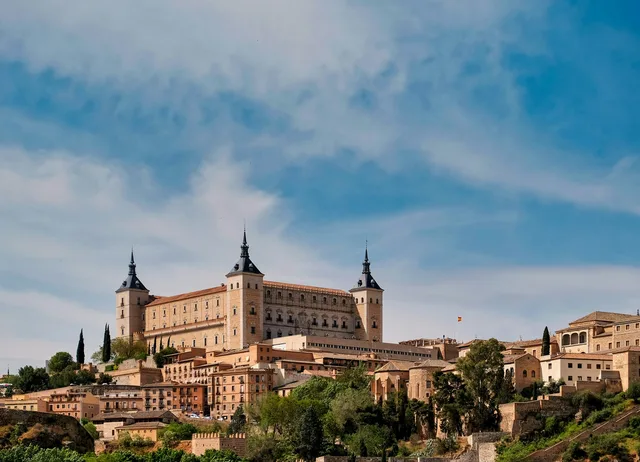
Toledo sits on a crag wrapped on three sides by the Tagus river gorge, and the old town is a knot of lanes that makes Google Maps give up. Christians, Muslims and Jews shared this city for centuries, and you can read it in the buildings. The Catedral Primada is a Gothic giant stuffed with art. A few streets away, the Synagogue of Santa María la Blanca hides white horseshoe arches that look more Córdoba than Castile. In the little church of Santo Tomé hangs El Greco's The Burial of the Count of Orgaz, and seeing it in the room it was painted for is worth the trip alone.
Toledo is bigger than Segovia, and it rewards a slow, full day. The catch is the climbing: the city is all uphill, uneven cobbles and stairs, and by midday the main streets fill with tour groups. Bring good shoes and leave room for a box of marzipan on the way back. Our Toledo day trip guide has a full itinerary.
Why visit Segovia: aqueduct and fairytale castle
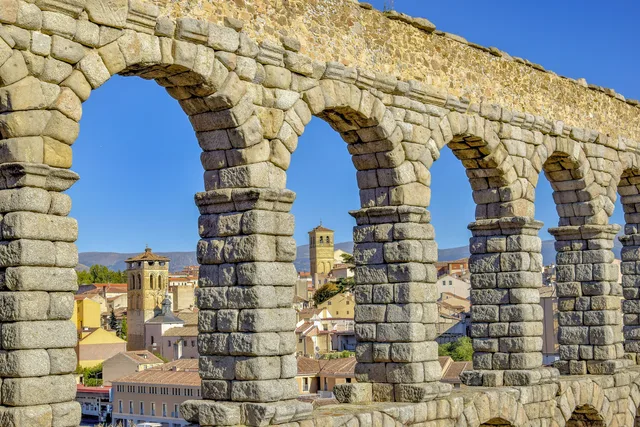
Segovia wins the first ten seconds. You step off the bus and the Roman aqueduct is right there: more than 20,000 granite blocks stacked without a drop of mortar, about 28 metres high at its tallest point, and still standing after almost 2,000 years. From there, Calle Real climbs gently to Plaza Mayor and Segovia Cathedral, the last Gothic cathedral built in Spain. Keep walking and the old town ends at the Alcázar, a castle on a rocky spur where two rivers meet. On a clear day the Guadarrama mountains fill the skyline behind it. Climb the Tower of Juan II for the best view in town (its tickets sell out first, so book ahead).
The whole route takes about 20 minutes on foot, which makes Segovia the easier sightseeing day for families and anyone short on time. Save room for cochinillo, the local roast suckling pig. Our Segovia day trip guide covers it step by step.
Legend
Legend has it that a young water-carrier, tired of hauling water uphill, made a deal with the devil: water at her door before the rooster crowed, in exchange for her soul. He worked all night, a storm slowed him down, and the rooster crowed with one stone still missing. She kept her soul, and locals will point out the gap where an image of the Virgin now sits.
Related guides

Toledo or Segovia: which is best to visit for you?
Choose Toledo if:
- You love art, churches and history, and want the richest single day trip from Madrid - You have a full day and don't mind hills - You would rather walk up from the station than wait for a transfer bus
Choose Segovia if:
- You're travelling with kids, only have half a day, or want to pair it with Ávila - You're visiting in July or August, when Segovia's altitude takes the edge off the heat
Let the calendar decide
Segovia sits roughly 1,000 metres above sea level, so in high summer it's the cooler escape: average July highs are about 30 °C against about 35 °C in Toledo, whose stone streets trap the heat all afternoon. In winter it flips. Segovia can be properly cold and windy, so pack a real coat.
Also, both "30-minute" trains leave you outside the old town. In Segovia the transfer bus adds about 20 minutes each way, so your door-to-door time from central Madrid is closer to an hour for either city.
Can you visit Toledo and Segovia in one day?
Yes, but only on an organised tour, and it's a long day. The Toledo & Segovia: Day Trip from Madrid starts at €59.00 and gives you a few hours of free time in each city, while the Toledo, Segovia and Avila: Day Trip from Madrid squeezes in a third city from €109.00. Honestly, we'd rather you see one city properly than both through a coach window. If you have two free days, do Toledo and Segovia on separate days by train.
Prefer a guide for just one? The Toledo: Guided Walking Tour + Roundtrip from Madrid starts at €34.00, and the Segovia: Full-Day or Half-Day Guided Tour from Madrid from €44.00. For more ideas, see our pick of the best day trip from Madrid.
Frequently asked questions
Is Toledo located in Madrid?
No. Toledo is in the neighbouring region of Castile-La Mancha, about 70 km south of Madrid. Segovia is in Castile and León, northwest of the city across the Guadarrama mountains.
Should I go to Ávila or Segovia?
Segovia, if you can only do one. Ávila's medieval walls are impressive, but Segovia has more to see in a day. Several tours combine the two.
When is Toledo Cathedral open on Sundays?
Only in the afternoon, from 14:00. Plan a Sunday trip around it, or go on another day.
What time does the Alcázar of Segovia open?
Every day from 10:00, closing at 19:30 from April to October and 18:00 from November to March. Last entry is 30 minutes before closing.
Toledo or Segovia: you can't really lose
If we had to pick blind, we'd send a first-timer to Toledo in spring or autumn and to Segovia in the heat of summer. Match the city to your season and your legs, and if Madrid hands you a second free day, go see the other one. Either way you'll be back in Madrid in time for a late Spanish dinner.