Why a Montserrat day trip belongs on every Barcelona itinerary
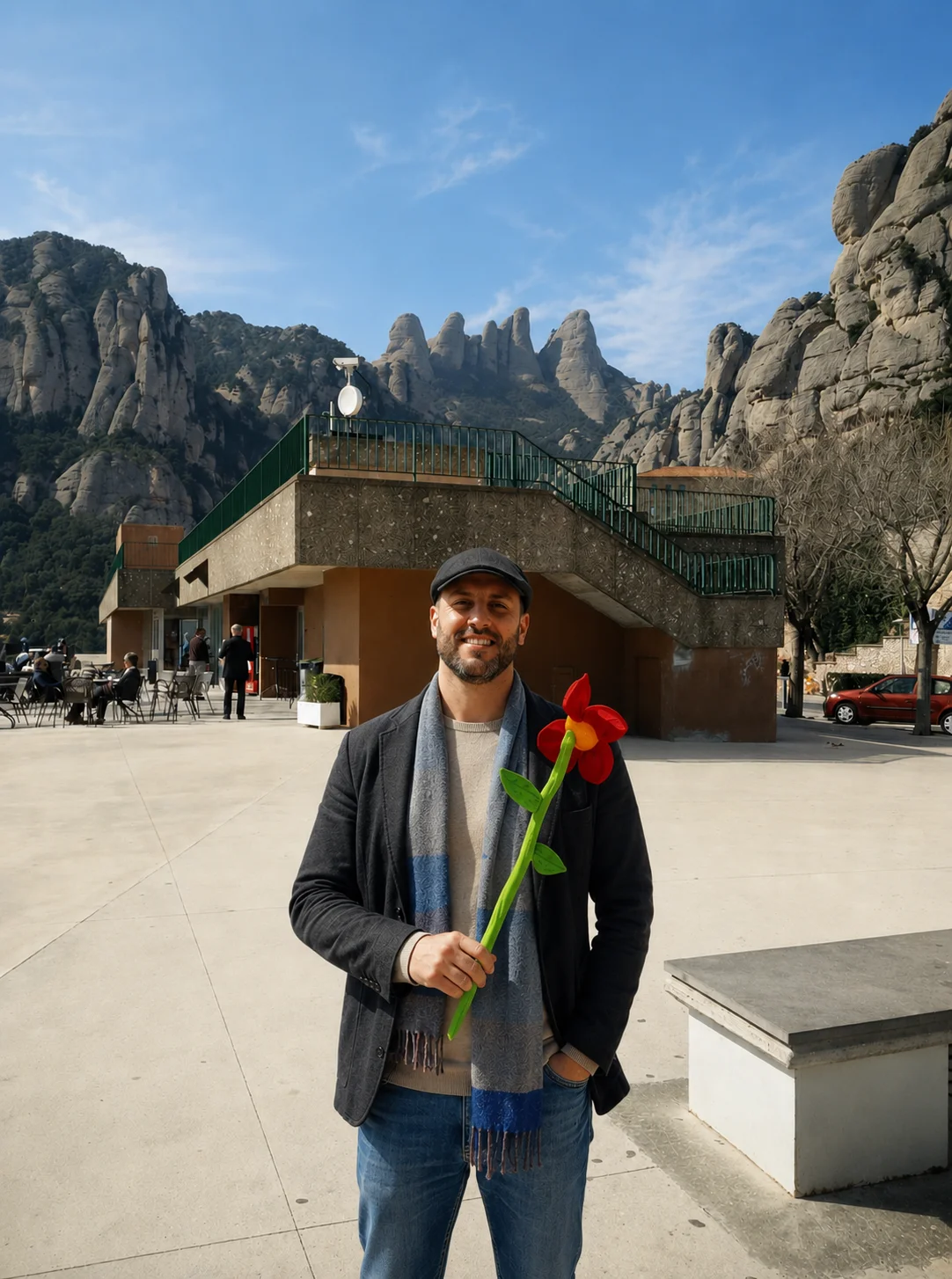
There are plenty of day trips from Barcelona, but none quite like Montserrat. An hour from the city, the mountain rises out of the Catalan plain in a series of jagged, other-worldly spires that have been pulling in pilgrims, poets and curious travellers for centuries. Perched on a ledge at 725 metres, the monastery has been here since the eleventh century. The energy of the place (part sacred, part like nowhere else) tends to catch people off guard.
This guide covers how to get there, what to see, how to time your visit and what most people miss.
Getting from Barcelona to Montserrat: train, cable car and rack railway
The most popular way to reach Montserrat is by train from Barcelona's Plaça Espanya station. Take the R5 FGC line towards Manresa. Trains run roughly every hour and the journey to Monistrol de Montserrat takes around 60 minutes. A Zone 4 single ticket costs approximately €6.90 one way (€13.80 return), with metro connections included at both ends.
From Monistrol de Montserrat station you have two ways up to the monastery. The first is the Aeri de Montserrat, a cable car that climbs steeply from the valley floor in about five minutes. It runs every 15 minutes (every 5 at busy times) and costs €10 one way or €15 return. It closes from January through late February each year. The second option is the Cremallera rack railway, which runs from Monistrol de Montserrat station and costs €8.70 one way or €14.50 return. Most visitors take whichever is running smoothly on the day. The cable car is faster and the views on the way up are hard to beat.
If you want everything bundled, the Trans Montserrat pass (around €50) covers the metro, the FGC train, the cable car or rack railway, and both mountain funiculars. For a full day that includes the museum and lunch, the Tot Montserrat pass (around €79.90) adds those on top. Both are sold at Plaça Espanya and online.
Visiting Montserrat Monastery: Santa Maria de Montserrat
Santa Maria de Montserrat is a Benedictine abbey that has sat on this ledge for almost a thousand years. Around 80 monks still live here, alongside a boys' choir, a museum and the famous statue that draws pilgrims from across the world. Entry to the basilica is free and it is open daily from 7am to 8pm.
To visit the Black Madonna, known in Catalan as La Moreneta or the Virgin of Montserrat, you join a separate queue that enters the basilica through a side door and passes directly in front of the twelfth-century statue. She sits in a gilded niche above the main altar, and even visitors with no religious connection find the moment unexpectedly moving. The Black Madonna is viewable between 8am and 10:30am and again from 12pm to 6:25pm. Arrive before 10am if you want to avoid the longest lines.
The Museu de Montserrat, near the monastery entrance, holds a collection that surprises almost everyone who visits: Egyptian mummies, Greek vases, medieval paintings and works by Monet, Picasso and Dalí. It opens at 10am and closes at 5:45pm on weekdays and 6:45pm on weekends. Admission is €10 or included in the Tot Montserrat pass.
The Escolania de Montserrat: hearing the boys' choir
The Escolania de Montserrat is one of Europe's oldest boys' choirs, founded in the thirteenth century. It performs in the basilica on a schedule that takes a little planning to catch. Performances run Monday to Friday at 1pm and 7:10pm, and Sunday at noon and 6:45pm. No performances on Saturday, during school holidays, or at Christmas and Easter. The choir takes its summer break in July. Check the official schedule before you go, because catching the choir turns a good visit into something you will remember for years.
Exploring Montserrat mountain: funiculars and hiking trails
The monastery is only the starting point. Montserrat is a natural park (the Parc Natural de la Muntanya de Montserrat) and the mountain rewards anyone willing to walk a little further from the crowds.
Two funiculars run from the monastery level. The Sant Joan funicular rises in about seven minutes to an upper station near 1,000 metres, running roughly 10am to 5pm (until 6:30pm in summer). From there, trails lead through the serrated rock formations to a ruined hermitage and, for those who continue, to the summit at Sant Jeroni (1,236 metres), roughly 1.5 hours of walking each way. On a clear day you can see the whole Catalan coastline from up there.
The Santa Cova funicular goes the other way, dropping to a path that leads to the Holy Cave, a baroque chapel marking the spot where the Black Madonna was said to have been discovered. The cliffside trail is easy and takes about 20 to 30 minutes each way. Along the path you pass bronze sculptures by Gaudí, Puig i Cadafalch and other Catalan modernist artists, which makes it feel like an open-air gallery as well as a pilgrimage route.
If you only have a half day, skip Sant Joan and walk the Santa Cova trail instead. You will reach the monastery, see the Black Madonna, browse the museum briefly and still catch the return train without feeling rushed.
Montserrat tours from Barcelona: guided and independent options
A guided tour suits visitors who prefer not to navigate tickets and timetables on their own. Options range from small-group departures (typically 8 to 15 people) to private arrangements for families or couples. A full-day tour usually covers transport from Barcelona, a guided visit to the monastery and basilica, time at the Black Madonna and often the Santa Cova trail. Worth considering if it is your first visit, if you are travelling with older relatives, or if you want the historical and religious context that is easy to miss walking around independently.
Going independently is straightforward and cheaper, and it gives you the flexibility to linger. The Trans Montserrat pass handles all the transport in one go and the signage throughout the mountain is clear.
Best time to visit Montserrat
Spring (March to May) and autumn (September to November) are the best times to visit. The light is good, the trails are at their most pleasant and the crowds are smaller than in summer. July and August bring the highest visitor numbers and afternoon heat that makes the upper trails uncomfortable. The boys' choir is also on its summer break in July, so if hearing the Escolania is on your list, factor that in.
Within the day, timing matters. Tour groups typically arrive between 10:30am and 2pm. Get there by 9am and you will have the Black Madonna queue almost to yourself. Arriving after 2pm also works well: the coaches begin to leave, the mountain quietens and the afternoon light on the rocks is stunning. Early morning is also when the monks say Lauds in the basilica, which is open to visitors and a far more intimate experience than the midday rush.
Staying overnight near the monastery
Most people do Montserrat as a day trip. Staying overnight is a different thing entirely. Once the day visitors leave on the last cable car, the mountain belongs almost entirely to the monks and a handful of guests. The Abat Cisneros hotel sits on the monastery square and has comfortable rooms looking out across the valley. The abbey also rents simple cells to pilgrims and visitors who want a more contemplative stay. Waking up with mist still in the valley below, with nothing but the sound of bells echoing off the rock, is one of the more extraordinary ways to spend a night near Barcelona.
Frequently Asked Questions
Is a Montserrat day trip from Barcelona worth it?
It is one of the best day trips in Spain, not just from Barcelona. The mountain is genuinely unlike anything else in the region, the monastery has real atmosphere and the journey takes just over an hour each way. Most people who go wish they had stayed longer.
How can I get to Montserrat from Barcelona?
Take the R5 FGC train from Plaça Espanya station towards Manresa. Get off at Monistrol de Montserrat, then take either the Aeri de Montserrat cable car or the Cremallera rack railway up to the monastery. Door to door from central Barcelona takes about 75 minutes. Alternatively, book a guided or private tour that includes transport from the city.
How long does the journey take?
The train from Barcelona to Monistrol de Montserrat takes around 60 minutes. Add 5 minutes for the cable car or 15 minutes for the rack railway. From central Barcelona, allow 75 to 90 minutes to reach the monastery.
How much does it cost to visit Montserrat in 2026?
The basilica is free. The FGC train costs around €6.90 one way (Zone 4 ticket). The Aeri de Montserrat cable car is €10 one way or €15 return. The rack railway is €8.70 one way or €14.50 return. The Trans Montserrat pass (around €50) bundles the train, cable car or rack railway and both funiculars. The Tot Montserrat pass (around €79.90) adds the museum (€10 separately) and a lunch buffet. A guided tour from Barcelona typically costs €40 to €75 per person depending on inclusions.
How long should I spend at Montserrat?
A half day (four to five hours at the mountain) is enough for the basilica, the Black Madonna queue and the Santa Cova trail. A full day lets you add the museum, the Sant Joan funicular and a walk towards the summit. Five to six hours at the mountain is the sweet spot for most visitors.
Are there hiking trails at Montserrat?
Yes. The Santa Cova trail (20 to 30 minutes each way from the lower funicular station) is the easiest and most popular. For something longer, the Sant Joan funicular takes you to the upper trails, including a two to three hour round trip to Sant Jeroni at 1,236 metres. The natural park has well-marked paths at various lengths and difficulty levels.
Is it possible to stay overnight at Montserrat?
Yes. The Abat Cisneros hotel is on the monastery square, and the abbey rents simple cells for visitors who want a quieter stay. Book well in advance, especially in spring and autumn.
What is the best time to visit Montserrat?
Spring (March to May) and autumn (September to November) offer the best weather and smaller crowds. Within the day, arrive before 9am or after 2pm to avoid the peak tour-group window, which runs roughly 10:30am to 2pm.
What is the Trans Montserrat pass?
The Trans Montserrat pass costs around €50 and covers the metro in Barcelona, the FGC train to Montserrat, the cable car or rack railway (return), and unlimited use of both mountain funiculars for the day. It is the most practical option for independent visitors who want to explore the mountain without buying separate tickets for each leg.
What is the Tot Montserrat pass?
The Tot Montserrat pass costs around €79.90 and includes everything in the Trans Montserrat ticket plus entry to the Museu de Montserrat and a set lunch buffet at the mountain restaurant. Worth it if you plan to visit the museum (otherwise €10) and want a straightforward, all-inclusive day.