Five Escapes Worth Leaving Barcelona For
Barcelona could keep you busy for two weeks and you still wouldn't run out of things to do. But some of the best days of a Catalonia trip happen the moment you step onto a train and leave the city behind. An hour in one direction puts you on a mountain that Catalans consider sacred. An hour in another and you are walking medieval streets that doubled as Braavos. South along the coast, the beaches multiply. Inland, the vineyards that make Catalonia's cava start right where the suburbs end.
Every trip below works as a single day out, and none of them need a car. Here is where to go, how to get there, and what makes each one worth the early alarm. If you prefer to plan around train routes specifically, see our dedicated guide to day trips from Barcelona by train.
Quick Comparison: Which Day Trip Suits You?
If you are choosing just one, here is the shortlist.
| Destination | Journey time | Best for | How to get there |
|---|---|---|---|
| Montserrat | About 1 hour, plus a 15-minute climb | Mountain views, monastery, hiking trails | R5 train from Plaça Espanya, then cable car or rack railway |
| Girona | About 40 minutes | Medieval old town, cathedral, Game of Thrones spots | High-speed train from Barcelona-Sants |
| Sitges | About 40 minutes | Beach mornings, old town afternoons | R2 train from Barcelona-Sants or Passeig de Gràcia |
| Tossa de Mar | About 1 hour 30 minutes to 2 hours | Walled old town, coves, Costa Brava views | Direct Sarfa bus from Estació del Nord |
| Penedès (Sant Sadurní d'Anoia) | About 45 minutes | Cava wineries, vineyard scenery | R4 train from Plaça Catalunya or Barcelona-Sants |
Montserrat: A Mountain Monastery With a Cable Car to Match
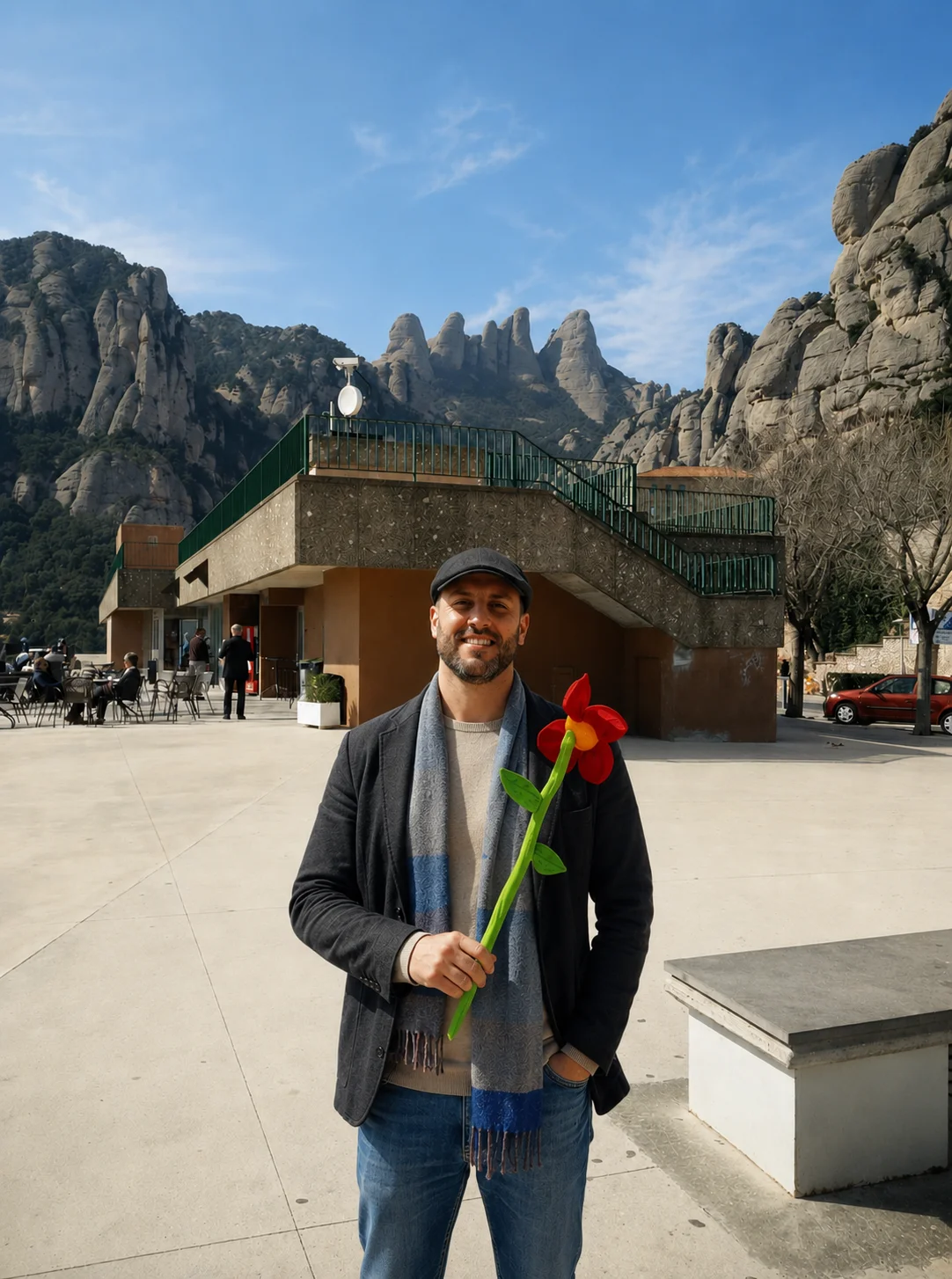
Montserrat is the day trip most people picture first, and it earns that reputation. The mountain rises out of the Catalan plain about 50 km northwest of Barcelona, its rounded grey peaks (the name means roughly 'jagged mountain') wrapping around a Benedictine monastery that has stood here, in one form or another, since the 9th century.
Getting there's half the experience. Take the R5 line from Plaça Espanya to Monistrol de Montserrat, a ride of just over an hour through increasingly dramatic scenery, then switch to either the rack railway or the Aeri cable car for the final climb. Both take around 15 minutes, and the views back down over the valley are worth the trip on their own. Combined train and mountain transport tickets are sold at the Plaça Espanya ticket office, so there's no need to book the connection separately.
At the top, the basilica holds La Moreneta, the dark wooden statue of the Virgin that has been Catalonia's patron for centuries, and beyond the monastery buildings a network of marked hiking trails climbs higher into the rock formations, with views that stretch toward the Pyrenees on a clear day. Even a short walk along one of the lower paths gets you away from the crowds around the basilica within ten minutes.
Legend
According to local tradition, the carved figure of the Virgin now kept inside the basilica was hidden in a cave on the mountain during an invasion centuries ago, then rediscovered by shepherds who followed the sound of bells and a strange light to the spot. The story goes that when monks tried to carry the statue down to a church in the valley, it grew too heavy to move past this point on the mountain, so they built the monastery around her instead. She has stayed on Montserrat ever since.
Local tip
Time your visit for 1pm on a weekday. That is when the Escolania, Montserrat's boys' choir and one of the oldest in Europe, sings inside the basilica, a few minutes that turn a sightseeing stop into something genuinely moving, and most tourists have no idea it's happening.
Catch one of the first trains of the day from Plaça Espanya and you'll reach the top before the tour buses arrive, leaving the viewpoints and the early stretch of the basilica close to empty.
Girona: Medieval Streets, a Cathedral and a Game of Thrones Cameo
About 40 minutes from Barcelona on the high-speed train, Girona feels like stepping into a different country. The old town climbs a hill above the Onyar river, its narrow stone streets, the Jewish quarter known as the Call, and a cathedral with the widest Gothic nave in the world all packed into an area small enough to cover on foot in an afternoon.
The cathedral's 90-step baroque staircase is the kind of spot that looks familiar even on a first visit, because it stood in for the entrance to the Great Sept of Baelor in Game of Thrones, and the narrow lane just behind the cathedral doubled as the streets of Braavos. Fans can spot half a dozen filming locations within a few minutes' walk of each other, though the city is just as rewarding for anyone who has never watched the show.
Don't skip the riverside walk along the Onyar, where houses in yellow, orange and pink stack up above the water and a red iron footbridge, designed by the same workshop behind the Eiffel Tower, gives the best photo angle of the lot. The train station sits about 10 minutes' walk from the old town, so there's no need for a taxi or bus on either end. Our complete Girona day trip guide covers the cathedral, El Call, the city walls, and where to eat.
Sitges: Beach Mornings, Old Town Afternoons
About 40 minutes south by train, Sitges trades cathedrals for sand. The town has seventeen beaches strung along its seafront, and the walk from the station to the water takes about ten minutes through streets lined with whitewashed houses and the occasional Modernista mansion left over from the 19th century, when wealthy traders returning from Cuba built their summer homes here.
Platja de la Ribera and Platja de Sant Sebastià, on either side of the headland, are the easiest to reach and stay calm even in the middle of the day. That headland is where the Church of Sant Bartomeu i Santa Tecla sits, its whitewashed bell tower the single most photographed view of the town and a short climb for views back over both beaches.
Save an hour for the old town behind the seafront, where narrow streets hide independent boutiques, the Museu del Cau Ferrat (the former home of a Catalan painter, packed with his collection of wrought ironwork and art), and enough cafe terraces to make choosing where to sit the hardest part of the day. Trains back to Barcelona run roughly every 15 to 20 minutes, so there's no need to plan around a fixed return time. For the full breakdown of train times, fares and the seat worth grabbing, see our dedicated guide to getting from Barcelona to Sitges.
Tossa de Mar and the Coves of the Costa Brava
Tossa de Mar is further out, about an hour and a half to two hours by direct bus from Estació del Nord, but it's the closest thing to a postcard Costa Brava view that Barcelona has within day-trip range. The town's defining feature is the Vila Vella, a walled medieval old town on a headland above the main beach, the only fortified medieval settlement still standing on this stretch of coast.
Walk the ramparts for views down over the curve of the bay, then drop into the old town's narrow streets, where whitewashed houses with blue shutters lean over alleys barely wide enough for two people. Below, the main beach gives way on either side to smaller coves, known locally as 'cales', each one a short walk along the coastal path and considerably quieter than the town beach in summer.
Buy a return bus ticket before you leave Barcelona. The Sarfa service from Estació del Nord runs directly to Tossa with no transfer, but return buses in the afternoon fill up fast in high season, and booking a return fare in advance avoids any scramble at the Tossa bus stop.
Penedès Wine Country: Cava by Train
Inland and south of the city, the Penedès wine region is where most of Catalonia's cava actually comes from, and it's close enough to visit by train with time to spare for lunch. The R4 line from Plaça Catalunya or Barcelona-Sants reaches Sant Sadurní d'Anoia, the unofficial capital of cava production, in around 45 minutes.
Freixenet's cellars sit directly across from the station, about as convenient as a winery visit gets, while Codorníu's much older cellars are a 30-minute walk or a short taxi ride away and can only be visited with a guided tour, which needs to be booked ahead. Both wineries combine a walk through cellars carved into the hillside with a tasting at the end, and the surrounding vineyards make for an easy stroll between sips.
If you would rather not choose between them, the combined Freixetren ticket bundles a return train fare with a winery tour and tasting, sold directly through Freixenet. Whichever you pick, this is the day trip to take slowly: there's no monument to rush to before closing time, just rows of vines, cellars built for a different century, and a glass of something cold at the end of it.
Frequently Asked Questions
What is the best day trip from Barcelona overall?
If you only have time for one, make it Montserrat for the combination of scenery, history and an easy half-day itinerary, or Girona if you would rather spend the day walking through a town than up a mountain. Families with younger children tend to do best in Sitges, where the beach gives everyone a reason to stop and the old town is small enough not to feel like a forced march.
Can I combine two of these trips in one day?
Technically yes for Sitges and Girona, since both are under an hour away in opposite directions, but it makes for a rushed day with very little time in either place. Montserrat, Tossa de Mar and Penedès each deserve a full day on their own, and trying to bolt on a second destination usually means cutting the best part of the first one short.
Is it better to rent a car or use public transport?
Public transport covers Montserrat, Girona and Sitges easily, with frequent direct trains and no parking to worry about. A car becomes useful for the Costa Brava, where having your own wheels lets you stop at smaller coves between Tossa de Mar and the bigger towns, or for visiting more than one Penedès winery without depending on bus connections between them.
How much should I budget for a day trip from Barcelona?
Self-guided trips by train or bus are inexpensive, since the main cost is the transport fare plus whatever you spend on food and entry tickets once there. Guided day tours that include transport, a guide and sometimes lunch cost more but take the planning out of your hands entirely, which is worth it for Montserrat or the wine region if you would rather not work out train times.
I am not keen on cable cars, can I still do Montserrat?
Yes. Both the rack railway and the cable car cover the same final stretch up the mountain, so anyone who'd rather not dangle from a cable can take the rack railway instead, a cog train that runs on tracks the whole way and feels closer to a steep tram ride than anything alarming.