Two Gaudí Masterpieces, Five Minutes Apart on Passeig de Gràcia
Stand on Passeig de Gràcia and you can see both of Antoni Gaudí's most photographed houses without moving far: Casa Batlló's wave of blue and gold tile glinting one way, and Casa Milà's grey stone curves rolling away in the other. If you've only got time, or budget, for one Gaudí house in Barcelona, the question of Casa Batlló or Casa Milà comes up constantly, and honestly, there's no wrong answer. But there is a right answer for you.
Both are UNESCO World Heritage Sites, both were designed by Gaudí for wealthy Barcelona families, and both will earn a spot on your camera roll. What's different is the experience inside: one is a riot of color and curves that feels like walking through a fairytale, the other is a masterclass in structure with one of the best rooftops in the city. Here's everything you need to choose between Casa Batlló and Casa Milà, or to fit both in before lunch.
On the same street, 500 metres apart
Casa Batlló: Gaudí's Most Colourful House
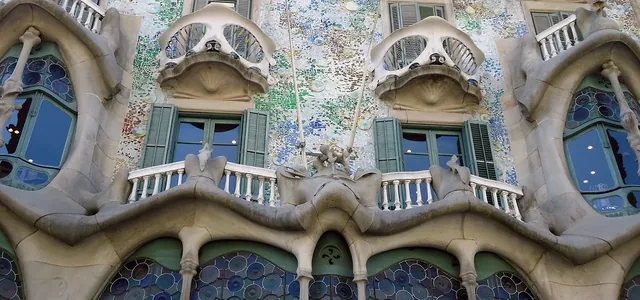
Casa Batlló sits at Passeig de Gràcia 43, and it's impossible to miss. The facade is covered in a wave of blue, green and gold ceramic tile that ripples in the light, with bone-shaped balconies and a roof that arches like the back of a sleeping dragon. Gaudí didn't build it from scratch: he was hired in 1904 to remodel an existing apartment block for the Batlló family, finishing the transformation in 1906 into one of the strangest, most beautiful private residences in Europe.
Inside, almost nothing is straight. The central staircase curves like a spine, stained glass windows pour blue light into the main hall, and even the door handles are shaped to fit a human hand (Gaudí designed them that way on purpose, look out for them). The rooftop, smaller than Casa Milà's but just as striking, is where the dragon imagery pays off.
Legend
Legend has it that Casa Batlló's entire rooftop is a tribute to Sant Jordi (Saint George), Catalonia's patron saint, who is said to have slain a dragon to save a princess. Look closely and the story is all there: the curved, scaled roof is the dragon's back, the tower topped with a cross is Sant Jordi's lance driven through it, and the bone-like balconies below are said to represent the dragon's victims. Whether Gaudí intended every detail this way is debated, but once a guide points it out, you'll never see the building the same way again.
Casa Milà (La Pedrera): Gaudí's Last and Largest House
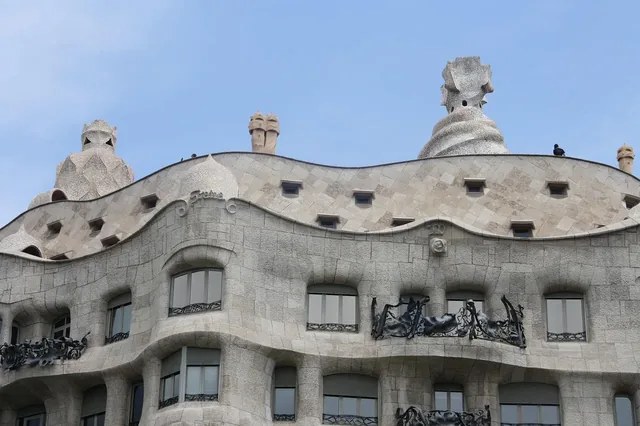
Walk up Passeig de Gràcia to number 92 and you'll find Casa Milà, better known to most Barcelona locals as La Pedrera, "the stone quarry." Built between 1906 and 1912 for the Milà family, it was Gaudí's final work before he devoted the rest of his life to Sagrada Família, and it shows: there's barely a straight line or right angle anywhere in the building.
Legend
According to local tradition, the nickname La Pedrera wasn't a compliment. When the building went up, its rough, undulating grey stone facade reminded Barcelona residents of an open quarry, and the name stuck as a bit of an insult. More than a century later, it's the building's defining feature, and the one most people search for by name.
The visit takes you through El Pis de la Pedrera, a recreated early 1900s apartment, an exhibition on Gaudí's work beneath the attic's whale-rib arches, and finally the rooftop, which is on a different scale entirely: a sculpture garden of staircases, chimneys and ventilation towers that look like helmeted warriors guarding the city.
Local tip
Because Casa Batlló and Casa Milà are only about 500 metres apart on the same street, you can realistically do both before lunch. Book Casa Batlló's first slot at 8:30am, when the morning light hits the stained glass and the crowds haven't arrived yet.
You'll be done by around 10am, leaving a relaxed seven-minute walk up Passeig de Gràcia to Casa Milà for a late-morning rooftop visit, before the midday sun makes it uncomfortably bright up there for photos.
Casa Batlló vs Casa Milà at a Glance
| Casa Batlló | Casa Milà (La Pedrera) | |
|---|---|---|
| Nearest metro | Passeig de Gràcia (L2, L3, L4) | Diagonal (L3, L5) |
| Hours | Daily, 8:30am to 10:30pm | Daily, 9am to 8:30pm (Mar-Oct) / 9am to 6:30pm (Nov-Feb) |
| Visit length | 60 to 90 minutes | 90 minutes to 2 hours |
| Rooftop | Dragon-back tiles, smaller, more intimate | Sculptural chimneys, larger, panoramic |
| Best for | Color, photography, shorter visits, families | Architecture lovers, rooftop views, longer exploration |
| From (audio guide ticket) | €29.00 | €29.00 |
So, Casa Batlló or Casa Milà? Here's the Quick Answer
If you're choosing just one: pick Casa Batlló if you want the most visually dramatic interior in under 90 minutes, especially with kids who'll love the dragon theme. Pick Casa Milà if you care more about architecture and want the rooftop experience many visitors rate as the best in Barcelona, and you have a bit more time to spend.
If you're combining a Gaudí house with Sagrada Família and Park Güell on the same day, Casa Batlló is the easier add-on simply because it takes less time. If Gaudí's work is the main reason you're in Barcelona, do both, and if your trip lands in 2026, both houses have extra reasons to visit thanks to Gaudí's centenary year. With an audio guide at each, you'll come away understanding how his style evolved from Casa Batlló's playful color to Casa Milà's pared-back, almost sculptural stone.
Whichever you pick, book a timed slot in advance. Both buildings sit at the top of every guided tour itinerary in Barcelona, and walk-up tickets in peak season, including Casa Batlló's nighttime events and Casa Milà's platinum ticket options, tend to sell out by mid-morning.
Frequently Asked Questions
Is Casa Batlló worth it?
Yes, for most visitors. It's compact enough to see in about an hour, and the interior, especially the main floor's stained glass and curved staircase, plus the dragon-themed rooftop, delivers one of the most photogenic hours you'll spend in Barcelona. For a full breakdown by visitor type, ticket tier, and when the honest answer is "skip it", read our dedicated Is Casa Batlló Worth It? guide.
Is Casa Milà worth it?
Yes, particularly if you enjoy architecture or photography. La Pedrera's rooftop chimney sculptures and the attic's arched ceilings are unlike anything else in the city, though the visit takes longer and rewards a slower pace.
Do I need to book tickets in advance?
Yes. Both attractions use timed-entry tickets, and popular slots, especially first thing in the morning and any nighttime experiences, sell out days or weeks ahead in high season. Booking online also avoids the higher walk-up prices at the door.
Should I add Casa Vicens to make it three Gaudí houses?
If you have the time, it's worth it. Casa Vicens was Gaudí's first major commission, smaller and quieter than the other two, and shows where his style started before it evolved into Casa Batlló and Casa Milà. It's a short metro ride from Passeig de Gràcia, so it pairs well with a full Gaudí day rather than a quick one, and in 2026 it's also taking part in Gaudí's centenary celebrations.