Madrid's Best Parks and Gardens: Where to Start
Madrid surprises most visitors with how green it is. The city has more than 6,000 hectares of parks and gardens, and a good number of them are free to enter, quiet on most mornings, and well worth the time. Whether you want to row a boat on a royal lake, stroll through a rose garden with 20,000 blooms, watch the sun set over an Egyptian temple, or discover the park that Marie Antoinette's own gardener designed for a Spanish duchess, the green spaces here go well beyond what most tourists expect.
This guide covers the best parks in Madrid for visitors, from famous to overlooked, with opening hours and practical tips for each.
El Retiro Park: Madrid's Heart and a UNESCO World Heritage Site
El Parque del Buen Retiro is the most famous park in Madrid, and it lives up to the reputation. Covering 125 hectares near the city centre, it holds a grand lake, two free art spaces, a formal rose garden, fountains, and more than 15,000 trees. In July 2021, UNESCO declared it a World Heritage Site as part of the Landscape of Light, a designation it shares with the adjacent Paseo del Prado. It was the first UNESCO designation in the city of Madrid.
Entry is free. The park opens at 6am and closes at midnight from April through September, and at 10pm from October through March. The Estanque Grande, a long rectangular lake watched over by the Alfonso XII monument, is the natural first stop. Rowing boats take up to four people and can be hired directly at the lakeside.
Two structures inside the park run free art exhibitions curated by the Reina Sofía Museum: the Velázquez Palace and the Crystal Palace. The Crystal Palace is the one to seek out: a soaring Victorian iron-and-glass pavilion where contemporary art is installed in a room flooded with natural light. Most visitors walk straight past it without realising it is open, which means it is almost always quiet inside.
Local tip
Near the Puerta de Alcalá entrance, the Parterre Francés formal garden contains what is believed to be Madrid's oldest living tree: a Mexican conifer nearly 400 years old. Most visitors walk straight past it. Park attendants can point you to it if the sign is hard to find.
| Detail | Info |
|---|---|
| Entry | Free |
| Hours (Apr–Sep) | 6am to midnight |
| Hours (Oct–Mar) | 6am to 10pm |
| Rowing boats | €6 weekdays / €8 weekends (45 min, up to 4 people) |
| Crystal Palace | Free, exhibitions by Reina Sofía Museum |
| Metro | Retiro (Line 2) or Atocha (Lines 1, 3) |
Madrid Río: 10 Kilometres Along the Manzanares
Madrid Río stretches for 10 kilometres along the banks of the Manzanares River, connecting several neighbourhoods through a continuous green corridor. It was completed in the early 2010s after the city buried a motorway that had previously cut the river off from the rest of the city. The result is a long, open park where you can cycle, run, or simply walk without any particular destination in mind.
The park has 17 play areas built from natural materials including wood and hemp rope. For families, it is hard to beat. In summer, a stretch between the Arganzuela footbridge and the Matadero becomes an urban beach, with fountains and water jets where children and adults cool down in the heat. There are sports courts, riverside cafes, and a handful of bridges commissioned from well-known architects that are worth slowing down to look at. Free to enter, open at all times.
Weekday mornings or early evenings are the best times to visit. Summer weekends get busy near the water features, but the park is long enough that quiet stretches are always easy to find.
Casa de Campo: The Largest Park in Madrid
Casa de Campo is the largest public park in Spain, covering 1,722 hectares on the western edge of the city. It is roughly five times the size of Central Park in New York. The estate served as a royal hunting ground from the mid-16th century, created by Philip II when he made Madrid the capital of Spain, and was opened to the public in 1931. Getting here is easy: walk in from the Puente del Rey bridge, take Metro lines 5 or 10 to stations at the park's edges, or ride the Teleférico cable car from Paseo del Pintor Rosales over the treetops and directly into the park.
Most of the park is open woodland and footpaths, ideal for cycling, running, or a long aimless afternoon among the trees. Inside you will also find the Madrid Zoo and Aquarium, the Parque de Atracciones amusement park, a large lake with bars and restaurants on its banks, an outdoor pool complex, and tennis courts. The park itself is free to enter; each attraction inside charges separately. Both the Madrid Zoo and the Parque de Atracciones have separate pages on this site with full ticket and pricing details.
The Temple of Debod and the Rosaleda in Parque del Oeste
The Temple of Debod is an authentic 2nd-century BC Egyptian temple, dismantled stone by stone and donated to Spain in 1968 after Egypt flooded the Nubian region to build the Aswan Dam. It was rebuilt on a raised terrace in Madrid, looking out across the Royal Palace and the Sierra de Guadarrama. No other city in Western Europe has anything like it.
The temple interior is free to visit, but capacity is limited to 30 people at a time with a maximum stay of 30 minutes. Groups are not admitted. Advance booking through the city portal is strongly recommended to avoid finding it full on arrival. Hours: 10am to 8pm from October to March, and 10am to 7pm from mid-June to mid-September. Closed Mondays and certain public holidays. The surrounding park is open at all times.
Local tip
The real reason to visit the Temple of Debod is the sunset. The temple faces west with a reflecting pool in front of it and the mountains on the horizon. Arrive at least an hour before sunset to get a position near the water. Weekday evenings are far less busy than weekends. Pick up drinks from a nearby shop on the way: there is nothing to buy on the terrace itself.
Directly below the temple, Parque del Oeste slopes down toward the river. The Rosaleda inside it is worth the walk in May and June, when its 20,000 rose specimens across 650 varieties are in bloom and the annual Popular Rose Contest is held. Entry is free, with seasonal hours from 10am to 6pm in winter up to 10am to 9pm in summer.
Campo del Moro and the Sabatini Gardens
Two parks sit directly alongside the Royal Palace, and both are regularly skipped by visitors who assume they need a palace ticket. They do not.
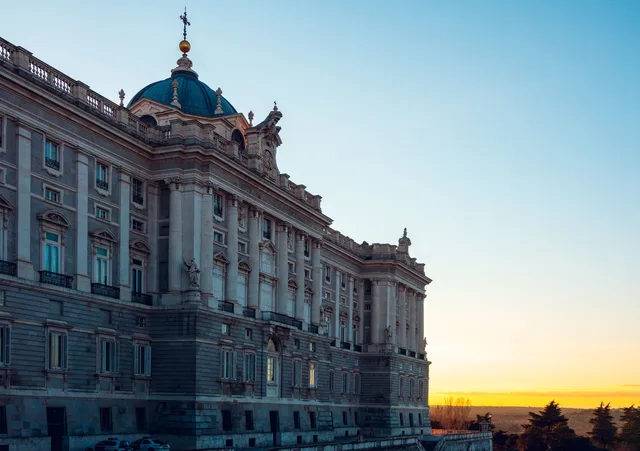
The Moro Gardens (Campo del Moro) occupy the grounds on the western face of the palace. From inside the garden you look up at the palace rising above you on the ridge while peacocks walk the formal paths and fountains fill the air. Few places in central Madrid are this atmospheric for a stroll, and the views up to the palace from inside are better than from most of the official viewpoints outside. Hours: 10am to 6pm in winter, 10am to 8pm in summer. Free. Three entrances: Cuesta de San Vicente (north), Cuesta de la Vega (south), and Paseo de la Virgen del Puerto (main). A terrace cafe opened inside the gardens in April 2025.
On the north side of the palace, the Sabatini Gardens are a formal neoclassical jardín with clipped hedges, fountains, and views up to the palace facade. Free and open from 9am to 9pm daily. Near La Latina, the tiny Jardín del Príncipe de Anglona, a walled 18th-century garden off Plaza de la Paja, is a peaceful oasis worth a few quiet minutes if you are in the neighbourhood.
Royal Botanical Garden: 5,000 Species Next to the Retiro
The Royal Botanical Garden (Real Jardín Botánico) sits directly adjacent to El Retiro Park on the Paseo del Prado. It is the one paid attraction in this list, but it earns its place: more than 5,000 species are displayed across terraced sections that range from historic botanical illustrations to tropical glasshouses. It is calm and well-shaded, and particularly good in spring when the rest of Madrid starts heating up. Check the official site for current prices and hours before visiting.
El Capricho: The Only Romantic Garden in Madrid
El Capricho is the park most tourists visiting Madrid never find, and that is precisely what makes it worth the trip. Built from 1784 for the Duchess of Osuna on the eastern edge of the city, it covers 17 hectares of layered gardens: a French parterre, an English landscape section, an Italian garden, a maze, a small lake, a bandstand, and a neoclassical palace. It is the only Romantic garden in Madrid, and it looks like nothing else in the city.
The origin is what sets it apart from every other park in the city. The Duchess of Osuna commissioned Jean-Baptiste Mulot, the French gardener who had designed the gardens of the Petit Trianon at Versailles for Marie Antoinette, to lay out El Capricho. Inspired by the royal gardens of England and France, the park was shaped by the same hand that shaped those royal estates. Goya visited regularly and painted The Spell here, a work now in the Lázaro Galdiano Museum. In April 2026, the renovation of the park's historic fort and dance hall was completed, restoring two structures that had been inaccessible for years.
Local tip
El Capricho is one of Madrid's best-kept secrets for good reason: it is only open on Saturdays, Sundays, and public holidays. Weekday visits are not possible. Hours are 9am to 6:30pm from October through March and 9am to 9pm from April through September. Entry is free. Take Metro Line 5 to Canillejas station, then walk around 10 minutes. Plan this visit in advance or you will arrive at locked gates.
Quinta de los Molinos: Madrid's Almond Blossom Season
For two to three weeks each February and March, Quinta de los Molinos becomes the most photographed park in Madrid. More than a thousand almond trees bloom together, covering the park in the Ventas neighbourhood with white and pale pink blossom. The display looks, from a distance, uncannily like a Japanese cherry blossom season, and it is one of Madrid's best-kept secrets for visitors who time their arrival right. The exact window shifts by year depending on temperatures, arriving anywhere from mid-February to mid-March.
Entry is free. The park is open daily from 6:30am to 10pm. Metro: Quintana or Las Musas (both Line 5).
Juan Carlos I Park: Space, Sculptures, and Free Bike Hire
Juan Carlos I Park sits next to the Feria de Madrid exhibition centre in the northeast of the city. At 160 hectares, it is one of the most spacious parks in Madrid, with a lake, a 9,500-seat open-air amphitheatre that hosts concerts and festivals in summer, and a perimeter running trail of around 5 kilometres. Free bicycle hire is available inside the park, one of the few in Madrid where you can pick up a bike on the spot without booking ahead. The lake is used for canoeing and fishing.
Inside the park, the Jardín de las Tres Culturas (Garden of Three Cultures) represents the Christian, Jewish, and Muslim heritage of Madrid through three distinct landscaped sections. Entry is free. Metro: Line 8 to Campo de las Naciones (around 10 minutes on foot to the park entrance).
Frequently Asked Questions
Are parks in Madrid free?
Almost all of them. El Retiro, Casa de Campo, Madrid Río, Campo del Moro, the Sabatini Gardens, Parque del Oeste, El Capricho, Quinta de los Molinos, and Juan Carlos I Park all charge no entry fee. The Temple of Debod interior is free but requires advance booking due to limited capacity. The Royal Botanical Garden is the main paid exception.
What is the most famous park in Madrid?
El Retiro (El Parque del Buen Retiro) is the most famous. It covers 125 hectares near the city centre, entry is free, and it was declared a UNESCO World Heritage Site in 2021 as part of the Landscape of Light alongside the Paseo del Prado.
What is the best time of year to visit parks in Madrid?
Spring (March to May) and autumn (September to October) offer the most comfortable temperatures and the best colour. February and March bring almond blossom to Quinta de los Molinos. May and June are peak season for the Rosaleda rose garden in Parque del Oeste. Summer is best managed with early morning or evening visits; Madrid Río's water features make it a strong summer choice for families.
How many parks are there in Madrid?
Madrid has hundreds of parks and green spaces. The most visited by tourists are El Retiro, Madrid Río, Casa de Campo, Campo del Moro, and Parque del Oeste. If you only have time for one beyond that list, make it El Capricho: it is the most remarkable park in the city that most visitors never find.
Is El Capricho Park worth visiting?
Definitely worth a visit for anyone who appreciates historic gardens. It is free, it is the only Romantic garden in Madrid, and it was designed by the same gardener who laid out the Petit Trianon gardens at Versailles for Marie Antoinette. The catch: it is only open on weekends and public holidays, so plan in advance.
Where is the best place to watch the sunset in Madrid?
The terrace around the Temple of Debod in Parque del Oeste is widely considered the finest sunset viewpoint in the city. The temple faces west with a reflecting pool in front and the Sierra de Guadarrama on the horizon. Arrive at least an hour before sunset, especially on summer weekends when the spot fills up quickly.