The Museo del Prado, Madrid: One of Europe's Greatest Art Collections
The Museo Nacional del Prado is home to over 8,000 works spanning seven centuries of European painting. Velázquez, Goya, Bosch, Titian, El Greco, Rubens: the masterpieces here are not "nice to see." They are the originals that shaped Western art. If you visit Madrid and skip the Prado, you have missed the point of the city.
Tickets cost €15 and can be booked online in minutes. Every evening, from 6pm Monday to Saturday and from 5pm on Sundays, entry is completely free. The museum also runs temporary exhibitions throughout the year alongside its permanent collection, so it is worth checking the website before you go to see what is on.
Las Meninas and the Masterpieces at the Heart of the Prado
Ask any art historian to name one painting that changed how we see pictures, and Velázquez's Las Meninas (1656) will come up immediately. The Infanta Margarita stands at the centre, surrounded by her ladies-in-waiting, while Velázquez himself stares out at you from behind a giant canvas. Who is he painting? The mirror on the back wall hints at the answer: you, the viewer, are standing where the King and Queen stood. Step back at least four metres to let the loose brushwork resolve into perfect realism. Up close it looks almost abstract; step back and the whole thing snaps into focus.
The Flemish art collection is extraordinary and easy to walk past too quickly. Hieronymus Bosch's Garden of Earthly Delights fills a room with medieval nightmare logic, while Rubens, Titian, and El Greco each have dedicated galleries. Zurbarán and the collection of Spanish painting deserve time too. Plan a rough route before you enter, or the first hour disappears in a pleasant daze.
Local tip
Most visitors walk straight past a small painting near the Italian collection that turns out to be the world's oldest known copy of the Mona Lisa, painted in Leonardo da Vinci's own studio alongside the original. Infrared analysis confirmed that when Leonardo made corrections to his version, the copyist made the same corrections in real time, working from an easel just metres away. The Prado acquired it centuries ago and only confirmed its origins after a full restoration in 2012. Look for it in the Italian painting galleries.
Goya's Black Paintings: Art Made for No One Except Himself
Francisco de Goya's Black Paintings occupy Rooms 67 and 68 on the ground floor, and they hit differently from the portraits he painted earlier in his career. Saturn Devouring His Son was painted directly onto the walls of his farmhouse on the outskirts of Madrid, not for exhibition and not for sale, just for himself. The Prado transferred the works onto canvas after his death. They are unsettling in a way that has nothing to do with gore and everything to do with watching a great mind under pressure. Allow at least 20 minutes here and do not rush them.
Museum Tickets, Prices, and Free Entry Hours
| Ticket type | Price |
|---|---|
| General admission | €15 |
| Reduced (65+, youth card, large families) | €7.50 |
| Under 18 / students 18–25 / disabled / teachers / journalists | Free (proof required at box office) |
| Mon–Sat 18:00–20:00 and Sun & holidays 17:00–19:00 | Free for everyone |
Buy tickets in advance online through the official museum website to skip the ticket queue entirely. For free evening entry, arrive 30 to 45 minutes before the doors open: lines build fast in summer, especially on Sundays. The museum also offers free all-day entry on 18 May (International Museum Day) and 19 November (its founding anniversary).
The Reina Sofía, the Thyssen-Bornemisza, and the Paseo del Arte
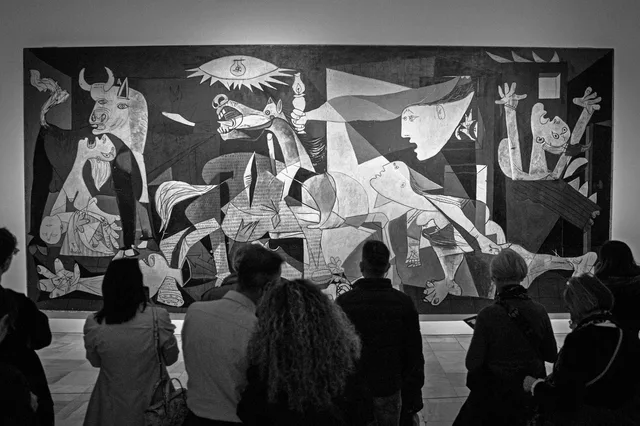
The Prado sits on the Paseo del Prado in the Retiro neighbourhood of central Madrid. The Reina Sofía museum, home to Picasso's Guernica, and the Thyssen-Bornemisza museum are both within a ten-minute walk, forming what Madrileños call the Paseo del Arte. You can visit all three in one full day, or spread them over two.
The museum is open Monday to Saturday from 10am to 8pm, and Sundays and public holidays from 10am to 7pm. It closes on 1 January, 1 May, and 25 December. The quietest times are weekday mornings right at opening and early afternoon from 2pm to 4pm. Photography is not allowed anywhere inside. Large bags must go in the free cloakroom near the entrance. The nearest metro is Banco de España (Line 2), about seven minutes on foot. After your visit, the Barrio de las Letras just west of the Paseo del Prado is packed with tapas bars. A long lunch there is a good way to process three hours of art.
Frequently Asked Questions
Is the Prado Museum worth visiting?
Yes, without hesitation. The Prado holds the world's finest collection of Spanish painting and one of the greatest collections of European art anywhere. The works by Velázquez, Goya, El Greco, Bosch, Titian, and Rubens are definitive originals, not reproductions or secondary examples. Most people who visit say it was the best museum they saw in Europe.
How long does a visit to the Prado take?
Three to four hours covers the major highlights comfortably. The museum holds over 8,000 works, so trying to see everything in one visit is not realistic. Decide in advance which rooms matter most (the Velázquez galleries, Goya's Black Paintings, the Flemish and Italian masters) and give yourself permission to focus on those rather than attempting the whole collection.
Can you take photos inside the Prado Museum?
No. Photography is banned throughout the museum, including in the permanent collection and temporary exhibitions. This is strictly enforced by staff. Leave the camera in your bag and use the time to actually look at the artwork.
What is the history of the Prado Museum?
The building was designed by architect Juan de Villanueva in 1785, originally intended as a natural history museum for King Charles III. Construction was never completed for that purpose. Ferdinand VII, encouraged by his wife Queen Maria Isabel de Braganza, reopened it in 1819 as the Royal Museum of Paintings, displaying works from the Spanish royal collections. The first catalogue listed 311 paintings, though the full collection already numbered over 1,500 from the various royal residences. It has been the Museo Nacional del Prado ever since.
Where is the Prado Museum and how do I get there?
The museum is at Calle de Ruiz de Alarcón 23, 28014 Madrid, in the Retiro neighbourhood along the Paseo del Prado. The nearest metro stop is Banco de España (Line 2), about a seven-minute walk. Estación del Arte (Line 1) is also close and drops you right at the edge of the art triangle. Buses 27, 34, 37, and 45 all have stops nearby.