Spain's Grandest Palace Is Right in the Heart of Madrid
The Royal Palace of Madrid, known locally as the Palacio Real, is one of the most extraordinary buildings in Europe. With 135,000 square metres of floor space and 3,418 rooms, it is the largest royal palace in Western Europe, bigger than Versailles and twice the size of Buckingham Palace. It sits on Calle Bailén in central Madrid, overlooking the Campo del Moro gardens and the distant Sierra de Guadarrama, flanked by the Almudena Cathedral on one side and the Plaza de Oriente on the other.
It is the official residence of the Spanish royal family, used exclusively for state ceremonies. King Felipe VI and his family actually live at the Palacio de la Zarzuela outside the city. That means the entire Palacio Real, all 3,418 rooms of it, is open to you.
The Construction of the Royal Palace: History Explained
A fortress has stood on this hill since the 9th century, when Muhammad I, the Umayyad Emir of Córdoba, built a watchtower here between 860 and 880 CE to guard the approach to Toledo. Over the following centuries it passed from Moorish to Castilian hands, was expanded by Charles V in the 16th century, and became the Royal Alcázar, the principal seat of the Spanish monarchy and home to Philip II, who ruled the largest empire in the world at the time.
Then, on Christmas Eve 1734, a fire broke out in the rooms used by French painter Jean Ranc. It burned for four days and destroyed the entire Alcázar. Philip V, who had grown up at Versailles and always found the Alcázar too medieval for his taste, saw his opportunity. He ordered a new palace built on the same site, this time entirely from stone and brick. No wood anywhere.
Philip V appointed Italian architect Filippo Juvarra to design it. Juvarra's vision was breathtaking: a palace four times larger than what was eventually built, inspired by Bernini's plans for the Louvre. He died in Madrid in March 1736 before construction began. His pupil, Giovanni Battista Sacchetti, took over the project, scaled it back to something the Spanish treasury could actually afford, and construction of the royal palace began in 1738. Charles III was the first monarch to occupy the new palace, moving in in 1764. He later commissioned the Neoclassical architect Francesco Sabatini to enlarge the building further. The palace as you see it today is Sacchetti's Baroque design with Sabatini's additions.
Inside the Palacio Real: What You Will Actually See
The interior of the Palacio Real is a procession of increasingly excessive state rooms, and the excess is the point. Every surface was designed to communicate power, wealth, and permanence to visiting dignitaries. It works.
The main staircase sets the tone: a soaring sweep of marble under a painted vault, wide enough to ride a horse up (and someone apparently did). The Throne Room, lined in crimson silk and gold, has a ceiling fresco by Giambattista Tiepolo completed in 1764 called "Apotheosis of the Spanish Monarchy." It covers the entire ceiling and ranks among the finest Baroque ceiling paintings in Europe. The Royal Armoury, one of the largest and most complete collections of armour and weapons in the world, holds pieces from the 13th century onward, including complete suits used by Charles V and Philip II.
Most visitors follow the main route and miss the Royal Pharmacy: an 18th-century apothecary preserved entirely intact, with original majolica jars, distillation equipment, and preparation rooms arranged exactly as they were when they served the royal court. It is tucked off the main route and easily overlooked. Do not overlook it.
Since June 2023, the Royal Collections Gallery (Galería de las Colecciones Reales) has been open beside the palace. It was 25 years in the making and cost €172 million to build. Seven levels descend underground, housing nearly 700 works spanning five centuries: Velázquez, Goya, Caravaggio, Titian, El Greco. During construction, archaeologists uncovered a section of the original 9th-century Arab wall, now preserved and on display inside the museo.
The Stradivarius story
Inside the palace, past the Throne Room and the armoury, there is a room most visitors walk straight past. Around 1700, Antonio Stradivari crafted a set of five instruments for the Spanish court: two violins, two violas, and a cello. During the Napoleonic occupation of Madrid (1808–1813), French soldiers stole both violas. One was recovered in the 1950s. The other has never been found. The remaining instruments (two violins, one recovered viola, one cello) are kept in climate-controlled cases and maintained in playing condition. A few times a year, musicians are invited to perform on them.
Royal Palace of Madrid Tickets: Prices and Free Entry
The standard self-guided visit costs €18 for adults. Reduced admission (€9) applies to children aged 5–16, seniors over 65, and students up to age 25. Children under five enter free. A combined ticket covering both the palace and the Royal Collections Gallery costs €24 standard or €12 reduced, with gallery access valid for seven days either side of your palace visit. An audio guide costs an additional €4.
| Ticket type | Standard | Reduced |
|---|---|---|
| Self-guided visit | €18 | €9 |
| Guided tour | €26 | €17 |
| Palace + Royal Collections Gallery | €24 | €12 |
| Audio guide | €4 | – |
Free admission
EU and Latin American citizens can enter without charge from Monday to Thursday during the last two hours of the day (17:00–19:00 in summer, 16:00–18:00 in winter). Bring your passport or national ID. Guided groups are not permitted during free entry hours, and queues at the gate can be substantial.
In spring and summer, queues at the box office regularly run 60 to 120 minutes. Book in advance through the Patrimonio Nacional website to skip the line. Guided tours in English run four times daily.
Visiting Times and Getting There
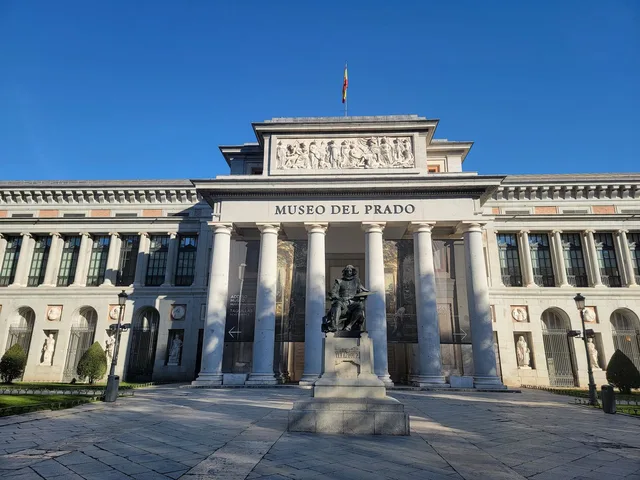
The Palacio Real is on Calle Bailén in central Madrid, a five-minute walk from Ópera metro station (Lines 2 and 5). It is also reachable from Plaza de España (Lines 3 and 10). The Prado museum is about 25 minutes on foot to the east, and Plaza Mayor is a short walk to the east.
| Season | Monday–Saturday | Sunday |
|---|---|---|
| April–September | 10:00–19:00 | 10:00–16:00 |
| October–March | 10:00–18:00 | 10:00–16:00 |
The box office closes one hour before the palace. Closed on January 1, January 6, May 1, and December 25, and it can close without notice for state ceremonies. Check the Patrimonio Nacional website on the morning of your visit if your timing is tight.
The view almost nobody gets
After your visit, walk down to the Campo del Moro gardens on the western side of the palace. Enter via Cuesta de la Vega. From the gardens, the full Baroque facade of the Palacio Real rises above manicured hedges and fountains, with the mountains behind it. This is the view on every postcard of the palace, and almost no one actually makes the walk down to see it in person.
Frequently Asked Questions
Is it worth visiting the Royal Palace of Madrid?
Yes, especially with the combined ticket that includes the Royal Collections Gallery. The Throne Room, the Royal Armoury, and the Stradivarius collection alone justify the entry fee. Plan at least two hours for the palace and another hour for the gallery.
Is it free to enter the Royal Palace of Madrid?
Children under 5 always enter free, as do people with a disability rating of 33% or above, unemployed persons with documentation, teachers, and large families with an official card. EU and Latin American citizens get free entry Monday to Thursday during the last two hours of the day, see the free admission tip in the tickets section above for exact times.
Does anyone live in the Royal Palace of Madrid?
No. King Felipe VI and the royal family live at the Palacio de la Zarzuela outside Madrid. The Palacio Real is the official residence of the Spanish royal family for state functions only.
Is there a dress code for the Royal Palace of Madrid?
There is no formal dress code. The floors are polished marble throughout, so comfortable shoes are strongly recommended.
How old is the Royal Palace of Madrid?
The current palace was built between 1738 and the 1750s, though a fortress has stood on this site since the 9th century. The original Royal Alcázar burned down on Christmas Eve 1734, and Philip V ordered the new palace constructed in its place.
Who designed the Royal Palace of Madrid?
Filippo Juvarra was appointed as first architect but died in 1736 before work began. His pupil Giovanni Battista Sacchetti designed the building as it stands today, in the late Baroque style. Francesco Sabatini later added Neoclassical elements under Charles III.
What is the architectural style of the Royal Palace of Madrid?
The palace is primarily late Baroque, with Neoclassical additions by Sabatini. The exterior features rusticated stone bases, Ionic columns, and grey granite contrasting with white limestone. No wood was used in the structure, a direct response to the fire that destroyed the original Alcázar in 1734.