The Modernist Mansion Most Visitors Miss
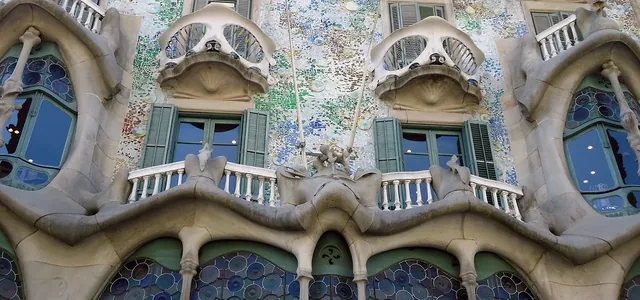
Stand on Passeig de Gràcia and look at number 43. That is Casa Batlló, and yes, the queues are long. Now look left, one door down at number 41. That stepped gable, those carved stone dragons, that riot of ceramic detail: that is Casa Amatller, and it belongs to Barcelona's modernist story just as much as its Gaudí neighbour does. The architect was Josep Puig i Cadafalch, the owner was a chocolate baron named Antoni Amatller, and the result is one of the most original façades on the Passeig de Gràcia.
What makes Casa Amatller different from the other modernist mansions on this block is that the family never left and never sold. The interior has been preserved almost untouched since 1900, which means the furniture, the stained glass, the tilework, and the collections are still in the rooms where they were placed more than a century ago. A visit here is less museum and more time capsule.
Antoni Amatller and the Chocolate Empire Behind the Building
The Amatller family did not grow rich overnight. Gabriel Amatller founded the chocolate business in Barcelona's Born district in 1797, and his descendants industrialised it aggressively. By 1879, chocolatier Antoni Amatller had opened a modern production plant in Sant Martí de Provençals capable of producing 11,000 kilograms of chocolate every day, making him one of the leading chocolatiers in Spain. The wealth that paid for this mansion came directly from cocoa.
But Antoni was more than a businessman. He was a passionate traveller and photographer who documented journeys through Morocco, Egypt, and Turkey. He collected archaeological glass, filling the main salon with over 750 objects spanning centuries and continents. He commissioned the finest Catalan craftspeople to fill the interior: Mario Maragliano for mosaics, Eusebi Arnau for sculpture, Gaspar Homar for the furniture. Every surface is a decorative decision, and every decision was Antoni's. The building is as much a portrait of its owner as a work of architecture.
Local tip
Look at the stepped gable on the façade. That distinctive shape is not purely decorative: the design is widely said to echo the corner of a chocolate bar, a nod to the family fortune that paid for the whole building. Whether Puig i Cadafalch planned it or the story grew later, it is a detail worth noticing once you know to look.
Also: the tile embedded in the pavement directly in front of the entrance marks the official starting point of the European Route of Modernism, a network connecting modernist heritage sites across Europe. You are standing at kilometre zero.
The Restoration That Put Casa Amatller Back to 1900
Between 2009 and 2015, the building went through a major restoration that returned every room to its original 1900 state. Restorers uncovered hidden Catalan patriotic verses behind the walls, a reminder of what it meant to build and decorate in Catalan during that era. Antoni's personal photographic studio in the attic was preserved alongside the equipment he used on his travels abroad. It is rare to find a modernist house where the life of the owner is still this legible in every corner.
Today the main floor operates as the Casa Museu Amatller, which opened in 2015. The upper floors house the Amatller Institute of Hispanic Art (Institut Amatller d'Art Hispànic), a research foundation that Antoni's daughter Teresa established in 1941. Its archive holds more than 360,000 photographic prints and 30,000 titles devoted to art history, one of the most significant collections of its kind in Spain.
Tickets, Tours, and the Chocolate Café
Two ways to visit. The audio-guided tour (from €21.00) covers the main floor at your own pace across seven languages, with departures every 30 minutes between 10:00 and 19:00. The guided tour (from €23.00) runs for one hour with an expert guide and ends with a chocolate tasting. Both give access to the preserved interiors, the glass collection, the tiled entry hall, and the neo-Gothic staircase beneath its stained-glass skylight.
| Ticket type | Price from | Duration | What's included |
|---|---|---|---|
| Audio guide (skip the line) | €21.00 | 45 min | 7-language audio guide, main floor access |
| Guided tour | €23.00 | 1 hour | Expert guide, chocolate tasting |
After the visit, the Faborit café on the ground floor occupies what was once the family's service area. It serves hot chocolate made from the original Amatller recipe and sells bars in the Art Nouveau packaging first designed by Alphonse Mucha. Stop in even if you skip the tour: the café is open to everyone, and the hot chocolate is not a gimmick.
Frequently Asked Questions
Is Casa Amatller a Gaudí building?
No. Casa Amatller was designed by Josep Puig i Cadafalch, a Catalan modernist architect who was Gaudí's contemporary. Gaudí's building on the same block is Casa Batlló at number 43. Together with Lluís Domènech i Montaner's Casa Lleó Morera, these three mansions form the Illa de la Discòrdia, the Block of Discord.
Who owns Casa Amatller?
The Fundació Institut Amatller d'Art Hispànic, the research foundation established by Teresa Amatller in 1941. The Amatller family never sold the building, which is why the 1900 interior has survived in such exceptional condition.
Is Casa Amatller worth visiting?
Yes, especially if you want Passeig de Gràcia modernisme without the Casa Batlló price and crowd. The preserved interiors are remarkable, the visit is shorter and more personal, and the audio guide is available in seven languages. Architecture fans who have already seen the major Gaudí buildings will find this a rewarding next step.
What can you see inside Casa Amatller?
The main floor covers the original furnished rooms, the glass and ceramic collections, and the staircase. Look out also for the attic: Antoni's personal photographic studio is up there, preserved with the equipment he used on his travels, and accessible on specialist weekend tours. It is one of the few places in Barcelona where you can see how a wealthy modernist collector actually lived and worked.
What other attractions are near Casa Amatller?
Casa Batlló is immediately next door at number 43. Casa Lleó Morera by Lluís Domènech i Montaner is a short walk along the same block. La Pedrera (Casa Milà) by Antoni Gaudí is about a 10-minute walk north along Passeig de Gràcia. The stretch between Carrer d'Aragó and Carrer de Provença is the densest concentration of Catalan modernist architecture in the city.