Madrid doesn't reveal itself in a weekend. The city runs on its own schedule, starting late and ending later, filling the hours in between with art, tapas, noise, and the kind of urban pleasure that sneaks up on you slowly. One week in Madrid is the minimum for actually feeling the place.
Seven days gives you room to breathe. You can visit the Prado twice. You can eat at 21:30 without forcing yourself to stay up. You can take a day trip to Toledo and come back in time for vermouth. This Madrid itinerary is built around how the city actually works, not how a tourist brochure would like you to think it does.
Day 1: Plaza Mayor, the Royal Palace and Sunset at the Egyptian Temple
Start at Plaza Mayor. The grand 17th-century square is best before 10:00, when the arcaded buildings and ochre facades still belong to the city rather than to the tour group coaches pulling up behind you. Walk west to the Mercado de San Miguel for a coffee and a tapa: it is touristy and prices run higher than you will find on Cava Baja, but for a first morning in Madrid the energy earns it. Weekday mornings before noon are manageable. Saturday afternoons are not.
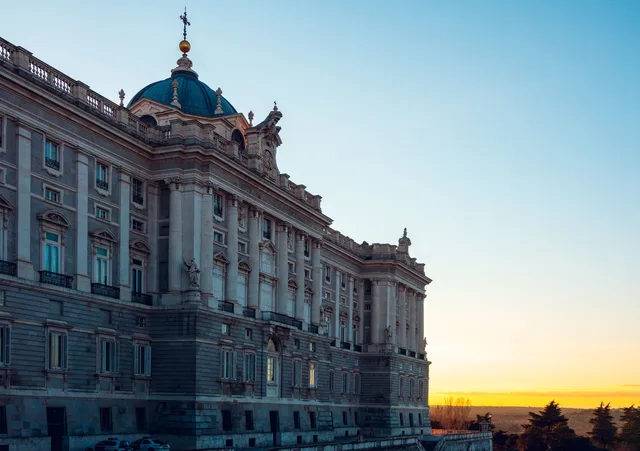
From there, the Almudena Cathedral and the Royal Palace are a short walk. The cathedral is vast and free. The Royal Palace is bigger: 3,418 rooms make it the largest royal palace in Western Europe by floor area. The current royal family, having decided it is too large to actually live in, opens most of it to visitors. Book your Royal Palace fast-track ticket in advance. This is one of the things to see in Madrid that genuinely sells out in peak season.
Local tip
EU citizens can enter the Royal Palace for free Monday to Thursday: 16:00 to 18:00 from October to March, and 18:00 to 20:00 from April to September. Bring your passport. The free queue and the ticketed entrance are different gates.
End Day 1 at the Temple of Debod (Templo de Debod): an ancient Egyptian temple built in the early 2nd century BC on the banks of the Nile, that ended up in a Madrid park. Egypt gifted it to Spain in 1968 as thanks for Spanish engineers helping save Nubian monuments threatened by the Aswan High Dam. The structure was dismantled stone by stone, shipped from Egypt, and opened to the public in Madrid in 1972. The interior is free. The real reason to come, though, is sunset. Arrive an hour before it happens, watch the ancient stone turn amber, and see its reflection settle into the pool below. It is the best photograph in Madrid, and it costs nothing.
Day 2: Visit the Prado (and Use the Evening)
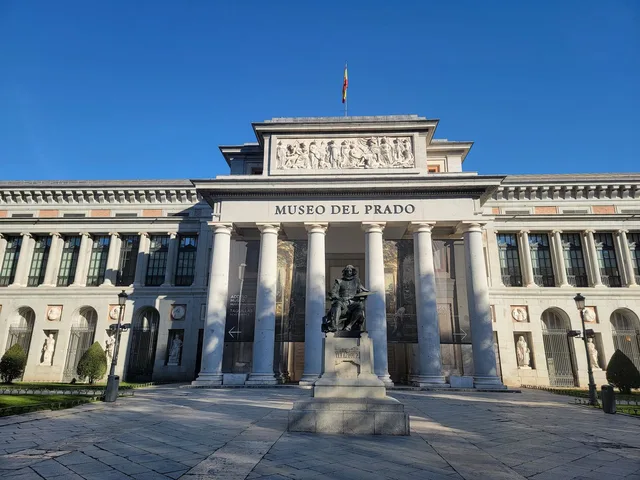
The Prado Museum is not a place to rush. Velázquez, Goya, El Greco: the world's finest collection of Spanish masters, all under one roof. Give it a morning. Start with Las Meninas and let the room do its work. The Goya rooms, including the Black Paintings originally applied directly to the walls of his house outside Madrid, will keep you there longer than planned.
The Prado is free every Monday to Saturday from 18:00 to 20:00, and on Sundays from 17:00 to 19:00. Most itineraries don't plan around this. You should. Visit in the late afternoon on a weekday instead. Monday to Thursday evenings are the quietest. Las Meninas at 19:30 on a Tuesday, in near-silence, is a different experience from seeing it at noon in a crowd.
Afterward, walk north into Retiro Park. This 125-hectare park is five minutes from the museum and contains, among other things, a 19th-century Crystal Palace (Palacio de Cristal) hosting free contemporary art exhibitions, a lake where you can rent a rowing boat, and a rose garden that peaks in May. Allow at least an hour.
Local tip
The Paseo del Arte Card covers entry to the Prado, Reina Sofía, and Thyssen-Bornemisza at a combined price of €40.00, saving around 20% on individual tickets. It is valid for a year, so you can spread the three museums across different days.
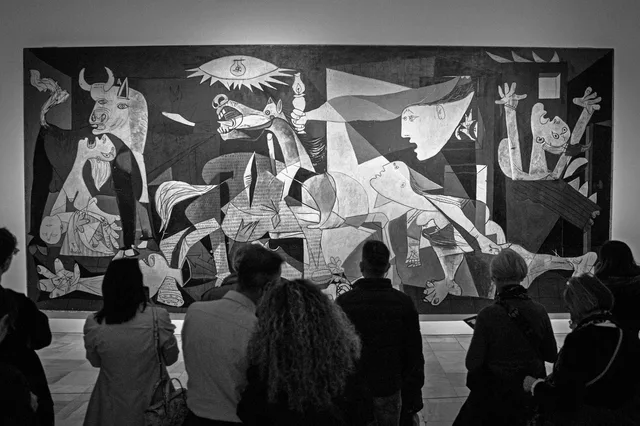
Don't try to visit the Prado and Reina Sofía on the same day. Museum fatigue is real, and Guernica deserves your full attention, not the blurry tail end of a six-hour art marathon.
Day 3: Guernica, Gran Vía and a Rooftop at Dusk
Reina Sofía is where Madrid keeps the 20th century. Picasso's Guernica hangs in its own room, lit and paced to stop you in your tracks. If you have never stood in front of it, you don't quite know what the painting is yet. Allow at least two hours. Dalí and Miró are also here, though they tend to play second fiddle. Booking a Reina Sofía skip-the-line ticket is worth it during peak season.
From Reina Sofía, walk north along the Paseo del Prado and into the heart of Madrid. Gran Vía, the city's grand early-20th-century boulevard, is worth walking at least once: not just for the theatres and department stores, but for the history written into its stones. Between 1936 and 1939, Nationalist artillery bombarded Gran Vía so relentlessly that Madrileños renamed it "Calle del Obús" (Shell Street). The Telefónica building, used as a Republican observation post, was a primary target. Look at the stone facade near Puerta del Sol today and you can still see the scars in the masonry.
End the day on a rooftop. The Azotea del Círculo de Bellas Artes on Calle de Alcalá has the most spectacular views of the centre of Madrid: rooftops, church towers, and the distant sierra. Book ahead and arrive before dusk. The views of the city at sunset are, frankly, unreasonable.
Day 4: Day Trip to Toledo
Take the train from Madrid-Puerta de Atocha. The journey to Toledo takes 33 minutes. Aim to arrive in Toledo by 09:30, ahead of the day-trip coaches.
Toledo rewards the early start. It's a UNESCO World Heritage Site on a hilltop above the Tagus, layered with Arabic, Gothic, Mudéjar, and Baroque architecture, and known as the City of Three Cultures for its intertwined Christian, Jewish, and Muslim heritage. The Church of Santo Tomé houses El Greco's masterpiece, The Burial of the Count of Orgaz, painted in 1586. There is also a dedicated El Greco museum, the Synagogue of Santa María la Blanca, and the Gothic cathedral, all within easy walking distance of Plaza Zocodover.
The best views of Toledo are from across the river: walk or take a taxi to the hills opposite, look back at the city on its rock, and understand immediately why this was the capital of Spain before Madrid.
If you'd rather explore with a guide, a guided Toledo day trip from Madrid includes transport, a walking tour, and cathedral access. Return to the capital by early evening.
Day 5: La Latina and the Sunday Ritual
If Day 5 falls on a Sunday, you have been handed one of the best mornings in Spain. El Rastro flea market takes over La Latina from around 09:00, winding through the streets south of Plaza de Cascorro and filling them with vintage clothes, old books, ceramics, and the kind of stall-by-stall browsing that can absorb two hours without effort. The market runs until about 15:00.
After El Rastro, move five minutes to Calle Cava Baja for the Sunday tapas ritual. Calle Cava Baja on a Sunday: old taverns, vermouth from the barrel, bravas, croquetas, jamón passed across zinc counters. The value is far better than the Mercado de San Miguel. Start no earlier than 13:00 and let the afternoon decide when you leave.
If Day 5 doesn't fall on a Sunday, La Latina still merits an afternoon. The neighborhood sits on a hill above the old city with narrow streets, 16th-century churches, and the kind of atmosphere that Madrid's center has been slowly trading away for years.
Legend
According to local tradition, a deal struck at El Rastro must be honoured, because backing out of a bargain made at the market brings bad luck for the rest of the year. The merchants of La Latina take this more seriously than you might expect. When you agree on a price, it stays agreed.
Day 6: Salamanca, the Thyssen and Flamenco in Madrid
Salamanca is Madrid's most elegant neighborhood: a 19th-century grid of wide boulevards east of the Retiro, built as a showcase for bourgeois prosperity. It suits a morning of slower walking, good coffee, and museum-going without the crowds that gather further west.
The Thyssen-Bornemisza Museum sits just south of the barrio on the Paseo del Prado. Originally a private collection, it was donated to Spain in 1993 by Baron Hans Heinrich Thyssen-Bornemisza. It covers 800 years of Western art, from Flemish primitives to American Pop, and it is the most approachable of the major museums in Madrid: smaller than the Prado, more chronologically legible, better lit. Start on Floor 2 and walk down through the centuries. Free on Monday afternoons from 12:00 to 16:00.
In the evening, see a flamenco show. Tablao Torres Bermejas, near Gran Vía, is one of Madrid's most established venues: Alhambra-inspired decor, professional dancers and musicians, shows lasting 90 minutes. Book a flamenco show at Tablao Torres Bermejas in advance, especially at weekends. Flamenco in Madrid is theatrical rather than raw, but when the guitar is good and the dancer's heels hit the floor, it closes a Madrid evening better than almost anything else.
Day 7: A Slow Morning and the Ghost Station Under Chamberí
The last day of any trip to Madrid should be slow. The monuments are covered elsewhere. What the city does better than almost anywhere is ease: the neighborhood café that produces a proper breakfast without ceremony, the bench in Retiro where nobody is in any hurry, the vermouth bar that opens at 11:30 and doesn't rush you out.
Before you leave, if it's a Thursday, Friday, Saturday, or Sunday, take Line 1 to Chamberí metro station and walk downstairs to Andén 0. This is a ghost metro station, sealed in 1966 when the platforms became too short for longer trains, and reopened in 2008 as a free museum. The result is one of the strangest and most quietly affecting spaces in Madrid: a perfectly preserved 1919 station, original tiles, vintage adverts, old signage, all frozen in the moment the station was closed. The current Line 1 trains still pass through on either side without stopping. Hours: Thursday 10:00 to 13:00, Friday 11:00 to 19:00, Saturday and Sunday 11:00 to 15:00. Entry is free.
You will almost certainly be the only tourist there. It is the best-kept secret in Madrid and, as a way to spend the last morning of a week in Madrid, it is close to perfect.
Local tip
If this is your last evening in Madrid and you haven't made it to the Prado yet, the free entry window on weekdays runs from 18:00 to 20:00. Monday to Thursday evenings are the quietest. On the first Saturday of each month it stays open until 23:30. One last hour with Las Meninas costs nothing.
Day Trips from Madrid: Toledo or the Segovia Day Trip?
Both Toledo and Segovia are easy day trips from Madrid and both are UNESCO World Heritage Sites. They are, however, completely different experiences.
Toledo takes a full day and rewards it: the El Greco museum, the Gothic cathedral, the synagogues, the views from across the Tagus. It is denser, older, and more historically layered than almost anywhere else you will visit on a trip to Madrid.
Segovia is lighter and more focused. The Roman aqueduct, built in the 1st century AD without mortar across 800 metres and more than 160 stone arches, is visible the moment you arrive in the city. The Alcázar, a medieval castle on a rocky promontory at the far end of the old town, is the other unmissable sight. Between them is the Gothic cathedral and a town that is genuinely more relaxed than Toledo. Arrive by 10:00 and the morning is yours.
If you only have time for one day trip, Toledo edges it for depth. If you are travelling with children or want something more manageable as a one day trip, the Segovia day trip is the better call.
How Many Days in Madrid Is Enough?
This is a question people ask before their trip and never ask again after it. Seven days in Madrid is not too many. It is, if anything, the point at which the city starts to open up: the neighborhood you hadn't gotten to yet, the second visit to the Prado, the Sunday lunch that ran into the evening without anyone noticing.
Days in Madrid pass well when you stop trying to see everything on day one. This itinerary for one week in Madrid is built around a sustainable pace: one big museum per day, one evening experience worth dressing for, one afternoon where nothing is planned. That is the experience in Madrid that makes people come back.
Is a week enough? Yes. Is it the maximum you'd want? Probably not. Love with Madrid tends to be the permanent kind.
Frequently Asked Questions
Is 7 days in Madrid too long?
No. Seven days gives you enough time for the major museums without rushing, at least one day trip, and genuine time in the neighborhoods. Most visitors say they could have stayed longer.
How many days do you need in Madrid?
Three days covers the core sights. Four or five allows for a day trip and some neighborhood time. One week in Madrid is the right length if you want to experience the city rather than just photograph it.
Is Toledo the best day trip from Madrid?
Toledo is the most rewarding in terms of depth: a UNESCO World Heritage Site packed with El Greco paintings, medieval architecture, and the history of the City of Three Cultures. Segovia is easier and more relaxed, ideal if you are travelling with children or want a lighter day. Toledo wins on substance, Segovia on ease.
Where should I stay in Madrid for a week?
The Centro district (around Sol, Ópera, and La Latina) puts you walking distance from the Royal Palace, Plaza Mayor, and the Paseo del Prado. Salamanca suits those who want quieter streets and upscale restaurants. Malasaña is better for a younger, more local feel.
Do I need a car for day trips from Madrid?
No. Toledo and Segovia are both served by direct fast trains from Atocha station. A car in central Madrid is an inconvenience rather than an advantage.
What is the Paseo del Arte Card and is it worth it?
The Paseo del Arte Card covers the Prado, Reina Sofía, and Thyssen-Bornemisza museums at a combined price, saving around 20% on individual tickets. Valid for one year, it lets you spread visits across different days rather than attempting all three museums in one go, which is inadvisable.
Is a week in Madrid enough to also see Barcelona?
Not comfortably. Madrid to Barcelona is a 2.5-hour train journey, but adding Barcelona turns a week in Madrid into a rushed split-city trip. It is better to give each city its own week. Madrid and Barcelona reward the dedicated trip.