Picture a man in a black cape and top hat sobbing into a handkerchief, walking behind a tiny coffin. Inside the coffin: a sardine. Behind him, a brass band, a crowd in masks and a giant papier-mâché king nodding along. This is how Madrid says goodbye to carnival, and it is one of the funniest evenings you can spend in the Spanish capital.
Carnival in Madrid is smaller than Rio's, more local and a lot more eccentric: five days of costumes, street music and old traditions that Goya himself painted two centuries ago. If your trip lands in February, it is a lovely bonus on top of the museums and tapas.
When is carnival in Madrid?
Carnival is tied to the date of Easter, so it moves every year. It always runs from the weekend before Shrove Tuesday to Ash Wednesday. In 2027 that means 6 to 10 February 2027, with the busiest days on the opening weekend.
| Day | What happens | Where |
|---|---|---|
| Saturday 6 Feb | Opening speech (pregón), family workshops, the big parade, afternoon dance party | Matadero Madrid and Madrid Río |
| Sunday 7 Feb | Manteo del pelele (straw-doll tossing), murgas and chirigotas | Plaza de Matadero |
| Mon to Tue | Smaller events in neighbourhood districts | Across the city |
| Wednesday 10 Feb | Burial of the Sardine | San Antonio de la Florida to Casa de Campo |
The city publishes the detailed timetable a week or two before. Check the local news before you go, because times shift slightly every year.
The popular carnival parade at Madrid Río
The main event is the Saturday parade along Madrid Río, the riverside park built over the old ring road. It starts at the Puente de Toledo, an 18th-century stone bridge, and ends at the Explanada Negra further along the park. Expect street theatre, circus acts, stilt-walkers in masks, giant puppets and a big contingent of Latin American groups from Bolivia, Ecuador, Colombia and beyond, dancing in full folk costume to live music. In 2026 it started at 1 pm.
It is all free. Matadero, a former slaughterhouse turned arts centre, becomes carnival headquarters for the weekend, with face painting and mask workshops for kids in the morning and a dance party in the afternoon. The nearest Metro stops are Legazpi (lines 3 and 6) and Marqués de Vadillo or Pirámides (line 5).
Local tip
Get to the riverbank by Puente de Toledo 30 minutes early and grab a spot on the slope by the water. You see the whole parade coming over the bridge, and you are not stuck behind a wall of phones filming video.
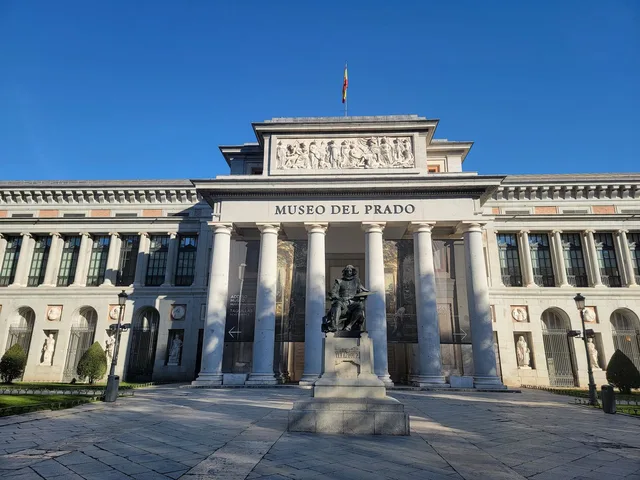
On Sunday morning, look out for the manteo del pelele: a straw dummy tossed into the air from a blanket by a ring of people. It sounds odd until you realise it is the exact scene Goya painted in El Pelele, which hangs in the Prado today.
The Burial of the Sardine
On Ash Wednesday at around 6 pm, the Alegre Cofradía del Santo Entierro de la Sardina (a merry brotherhood active since the late 1960s) sets off in mourning dress from the chapel of San Antonio de la Florida. Mourners wail theatrically, giants and big-headed figures dance alongside, and the procession follows the Manzanares to the Fuente del Pajarito in Casa de Campo, where the sardine is laid to rest around 9 pm. Carnival is officially over. Lent can begin.
Legend
The story goes that King Carlos III ordered a shipment of sardines for the people of Madrid to eat at the start of Lent. By the time they arrived, they had rotted, and the stench was so bad they had to be buried by the river. Another theory says the "sardine" was originally a side of pork, buried as a farewell to meat. Nobody really knows, which is half the fun.
The masked ball at the Círculo de Bellas Artes
If you want the grown-up version, the Círculo de Bellas Artes on Calle de Alcalá throws a legendary masked ball on carnival Saturday. Its gorgeous early 20th-century halls fill with costumes, DJs and live acts from about 10:30 pm until 6 am. Unlike the street events, it is ticketed and sells out, so book as soon as the date is announced. Nobody checks at the door, but you will feel underdressed without a costume.
A Goya trail through carnival
Most visitors never connect the dots, but Goya painted Madrid's carnival more than once, and you can follow him through the whole week.
Our favourite carnival detail
Start at the Real Academia de Bellas Artes de San Fernando (Calle de Alcalá 13) and stand in front of Goya's The Burial of the Sardine, painted around 1812 to 1819: masks, dancing, a little madness. The Círculo ball is a short walk up the same street. Then, on Ash Wednesday, notice where the sardine procession begins: San Antonio de la Florida, the chapel where Goya painted the ceiling and where his remains have rested since 1919 (minus his head, a mystery that has never been solved). The party literally starts at Goya's tomb.
Is Madrid carnival worth planning a trip around?
Honestly, it depends. If you want sequins and samba on a huge scale, Spain's top carnivals are in Cádiz and Santa Cruz de Tenerife, where the whole city stops for a week. Barcelona's version is lively too, especially in Sitges down the coast.
Madrid's carnival is best as part of a winter city break. A long weekend gives you the parade, a masked ball and the Prado, and February means short museum queues and cheaper places to stay. If you are around on Wednesday, go to the sardine burial. It is gloriously silly, and you will be telling people about it for years.
What to wear
February nights in Madrid can drop close to freezing. Plan a costume that fits over a warm layer, and bring gloves for the Ash Wednesday procession, which finishes in the dark in Casa de Campo.
Frequently asked questions
Can I bring kids to the Burial of the Sardine?
Yes, children love the giants and the fake wailing. Just keep in mind it walks a fair distance along the river and ends after dark, so younger kids may prefer to join for the start at San Antonio de la Florida and head back early.
Do people dress up for carnival in Madrid?
Plenty do, especially families with kids at Matadero and everyone at the masked balls. You will not feel out of place in a mask, a wig or a full costume.
How is carnival celebrated elsewhere in Spain?
Every region does it differently. Cádiz is famous for satirical singing groups called chirigotas, Santa Cruz de Tenerife for enormous Rio-style parades, and Sitges near Barcelona for its flamboyant late-night processions.
Is carnival a public holiday in Madrid?
No. Shops, museums and restaurants keep normal hours, so you can mix carnival with regular sightseeing all week.
Carnival is Madrid at its least serious: a city that spends the rest of the year rushing around, stopping for a few days to toss dummies in blankets and cry over a fish. Bring a mask, bring a coat, and join in.