Two capitals, one peninsula, and an hour of your life handed back the moment you cross the border. Madrid and Lisbon sit about 625 km apart, and the trip between them is one of the easiest add-ons to a Spain holiday. You can be eating jamón in a Madrid bar at breakfast and watching the yellow trams climb Alfama by lunch.
The catch is choosing how. There are four real ways to travel from Madrid to Lisbon: fly, take a direct bus, piece together a train journey, or drive. Each wins at something different, and the fastest on paper is not always the fastest door to door.
Ways to get from Madrid to Lisbon at a glance
| Option | Journey takes | Depart Madrid | Arrive Lisbon | Best for |
|---|---|---|---|---|
| Flight | 1h 15m to 1h 25m in the air | Adolfo Suárez Madrid-Barajas | Humberto Delgado Airport (LIS) | Short trips, saving time |
| Direct bus | 6h 10m to 8h 30m | Estación Sur (Méndez Álvaro), some from Barajas airport | Lisboa Oriente or Sete Rios | Tight budgets, overnight travel |
| Train (2 changes) | 9 to 10 hours, often more | Chamartín or Atocha | Santa Apolónia | Slow travel and scenery |
| Car | About 6 hours without stops | Anywhere | Anywhere | Road trips with stops |
One thing every timetable hides: Lisbon is one hour behind Madrid all year round. A flight that leaves at 08:00 lands at about 08:25 Portuguese time, which feels like magic going west and stings a little coming back.
Flight from Madrid to Lisbon: the quickest way
If you only have a few days, fly. Daily flights between Madrid and Lisbon run from early morning to late evening, and the airlines fly the route often enough that you rarely need to plan your day around it. Iberia, TAP Air Portugal, Ryanair, easyJet and Air Europa all operate a direct flight on this route, so you have both full-service and low-cost choices.
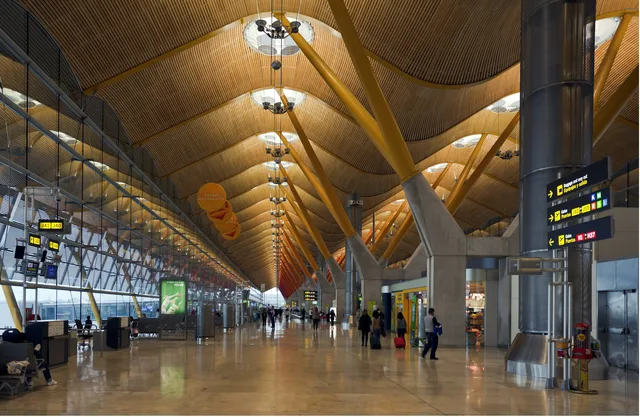
The flight departure is from Adolfo Suárez Madrid-Barajas Airport, and you land at Lisbon Humberto Delgado Airport (LIS), which many older guides still call Lisbon-Portela airport. Time in the air is about an hour and a quarter. Add the trip out to Barajas airport, security, boarding and the ride into Lisbon, and the real door-to-door time is closer to four or five hours. Still the quickest, just not the 75 minutes the booking site shows you.
Good to know
Every flight from Madrid lands at Lisbon's Terminal 1, and the metro station is right there. The Red Line gets you towards the centre in about 20 minutes, changing at Alameda or São Sebastião depending on where you are staying.
Going home is different. Ryanair and some other low-cost airlines depart from Terminal 2, a separate departures-only building with no metro. Take the metro to Terminal 1, then the free shuttle bus, and give yourself an extra 20 to 30 minutes.
Flight deals and when to book
The best prices on flights to Lisbon usually go to people who book a few weeks ahead and stay flexible on the day of the week. Early morning and late evening departures tend to be cheaper. For cheap flights from Madrid, low-cost airlines often show the lowest fare, but read the luggage rules carefully: the base ticket usually covers only a small under-seat bag, and a cabin suitcase can double what you pay. A round-trip flight with Iberia or TAP that includes a bag can work out better value than it first looks, so when you compare flight deals from Madrid to Lisbon, compare the final total with bags, not the headline fare.
Bus from Madrid to Lisbon: cheap and direct
This is the option first-time visitors tend to overlook. A direct bus runs between the two capitals several times a day, and on the fastest services the journey takes about 6h 10m. That is less time than the train and, once you count airport hassle, not dramatically slower than flying.
FlixBus operates a bus from Madrid to Lisboa Oriente, with the quickest trips at about six hours and others closer to 7h 45m. BlaBlaCar runs bus services on the same route, about three times a day, at around 7h 35m. ALSA, Spain's biggest coach company, runs to Sete Rios in Lisbon in about 8h 20m to 8h 30m. Some departures leave at night, so you can travel overnight and save a hotel night if you sleep well sitting up.
Most buses depart from Madrid's Estación Sur at Méndez Álvaro (Metro line 6), and some also stop at Barajas airport. Coaches have reclining seats, toilets and usually wifi, and the luggage allowance is far more generous than a low-cost airline. Bring your passport: Spain and Portugal are both in the Schengen area, but bus companies still check ID at boarding. You can compare bus times from Madrid to Lisbon and book in one place, side by side with flights.
Local tip
Pick Oriente over Sete Rios if you can. Lisboa Oriente station is a striking glass-and-steel hub where the metro Red Line, trains and taxis all meet. The airport is five minutes away by metro, which makes it the easy choice if you are flying home from Lisbon. Sete Rios is fine, but it is a plainer station a little further from the sights.
Related guides


Madrid to Lisbon train: possible, but not direct
Sorry to be the bearer of bad news: there is no direct train from Madrid to Lisbon. The old Lusitania night train, where you fell asleep in Madrid and woke up near the Tagus, was suspended in March 2020 and never came back.
You can still do it by rail, but it is three trains and two bookings:
1. Madrid to Badajoz on Renfe, usually an Alvia train from Chamartín or Atocha (the station's full name is Madrid-Puerta de Atocha-Almudena Grandes), or a slower Media Distancia service with a change at Mérida. 2. Badajoz to Entroncamento on a small Portuguese CP regional railcar, a single coach with no reservations and no café. 3. Entroncamento to Lisbon Santa Apolónia on a CP Alfa Pendular or Intercity train.
There are usually two workable combinations a day, and the journey takes 9 to 10 hours including transfers, sometimes more. The Spanish leg often goes on sale only a few weeks ahead, while Portuguese tickets open about 60 days before travel. Going west, you can usually book the whole Madrid to Lisbon train combination in one booking instead of buying each leg separately. Remember that Badajoz times are Spanish time, and the clock drops an hour as soon as you cross into Portugal.
Why would anyone do this? Because it is the most interesting way to travel from Madrid. You cross the dry plains of Extremadura, roll over the border, and stop at wayside stations with blue-and-white tiles. Bring snacks, a book and patience.
The stop most tourists never make
The Portuguese railcar stops at Elvas, shortly after the border. Elvas is a UNESCO World Heritage town, and its star-shaped walls are the largest bulwarked dry-ditch fortifications in the world, according to UNESCO. They were built to guard exactly the road you are travelling: the crossing between Madrid and Lisbon.
If you are taking the slow train anyway, consider breaking the trip with a night in Elvas or Badajoz. It turns a long travel day into two easy ones and adds a place almost no one on the Madrid to Lisbon route ever sees.
A faster link is coming. A new rail line between Évora and Elvas has been built and is in testing, and Renfe and CP are reportedly discussing a daytime Madrid-Lisbon train. There is no confirmed start date yet, so for now the slow route is the only rail option.
Driving from Madrid to Lisbon
The driving distance is about 625 km, roughly six hours without stops. The usual route follows the A-5 west through Extremadura to Badajoz, which is toll-free on the Spanish side, then motorways through the Alentejo into Lisbon, which do charge tolls.
Driving makes sense if you want to stop along the way: Trujillo, Mérida with its Roman theatre, Badajoz, Elvas or Évora are all close to the route. It makes less sense for a straight there-and-back. One-way rental fees for picking up in Spain and dropping off in Portugal can be very high, so get a written quote first, and tell the rental company you are crossing the border.
Some Portuguese motorways have electronic tolls only, with nowhere to pay on the road. Ask for a toll transponder when you collect the car, or you may get a fine forwarded weeks after you are home.
Prefer to share the drive? Check out BlaBlaCar's carpooling service for rideshare options. It is common on this route and lets you split costs with a local driver.
Which is the best way to get from Madrid to Lisbon?
If you are short on time, fly: nothing else gets you there faster, and you land with the metro waiting. On a budget, take the bus to Oriente, which is direct, simple and often a fraction of a last-minute fare. If you travel light and love the journey itself, take the train and stop in Elvas. And if a road trip is the point, drive and give Extremadura a day of its own.
For most first-time visitors on a one-week Spain and Portugal trip, the honest answer is a flight. For anyone with a spare day and a sense of adventure, the bus or train gives you something the plane never will: the moment you notice the signs have switched to Portuguese.
Frequently asked questions
Is Madrid or Lisbon better?
They are very different. Madrid is grand, late-night and full of world-class art museums. Lisbon is hilly, by the water and slower-paced, with viewpoints, tiled facades and pastéis de nata. If you can, see both: they work well together on one trip.
How many days do you need in Lisbon?
Three days covers the main neighbourhoods (Alfama, Baixa, Chiado, Belém). Add a fourth if you want a day trip to Sintra.
Do I need a passport to travel from Madrid to Lisbon?
There are no routine border checks between Spain and Portugal, but airlines and bus companies ask for ID, so carry your passport.
Can I travel at night from Madrid to Lisbon?
Yes, by bus. Some coach services run overnight. There is no night train since the Lusitania sleeper stopped in 2020.
Start your journey
Madrid to Lisbon feels like a bigger trip than it is. New country, new language, and the Atlantic at the end of it. Pick whichever way suits your days and your budget, set your watch back an hour, and save room for a warm pastel de nata when you get there.